The cost of cold: New economics research links frozen crops to domestic violence
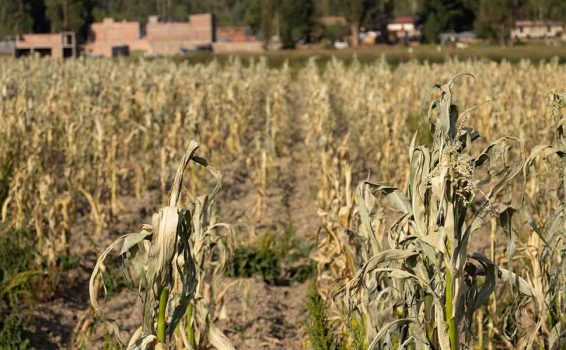
In December 2023, the Peruvian Andes were hit by a severe drought followed by a wave of nighttime freezing temperatures. The “cold shock” didn’t just wither crops and cause widespread hunger; it reached deep into the homes of the families who live there.
“We knew that households in the highlands of Peru faced loss of income from exposure to sub-zero conditions. And they were also confined indoors due to the weather,” said economist Leah Lakdawala.

“There can be bad circumstances when you’re trapped inside with someone who could be potentially dangerous, and who is, on top of that, under a lot of financial stress. There are plenty of agricultural communities worldwide, not just in Peru, even in the United States, that suffer the consequences when it gets very cold.”
The ‘double jeopardy’ of cold
By analyzing nearly a decade of data from the Peruvian Highlands—a region where extreme cold events are becoming more frequent—Lakdawala and her colleagues identified two primary ways that prolonged extreme cold affects family well-being.
Forced time indoors during frigid weather can cause anxiety, restlessness and irritability – also known as “cabin fever.” In homes with a history of domestic violence, being trapped inside during a long cold snap could be potentially dangerous, Lakdawala explains.
However, the research found a second, more powerful driver: economic despair. In agricultural communities, extreme cold can kill crops and livestock, potentially destroying a family’s livelihood in a single night.
“At least three-quarters of the increase in violence is really because of the financial stress put on households,” Lakdawala said. “It’s not just being stuck in the house; it’s being stuck in the house while under an incredible amount of financial pressure.”
A policy-driven safety net
Lakdawala’s research offers an encouraging finding for policymakers. The study found that in areas where the government provided better access to social programs, including a conditional cash transfer program, the spike in violence during cold shocks virtually disappeared.
One of the silver linings is that this is an addressable problem through policy.”
Economics professor Leah Lakdawala
“Providing a steady stream of income that isn’t affected by how cold it is outside gives households a safety net. It ensures they can cover basic necessities like food and rent, so they aren’t in a place of pure despair when the crops die,” said Lakdawala.
From numbers to narratives
Senior Juan Londoño, who will be graduating with a double major in economics and philosophy, joined Lakdawala’s research team as a sophomore. As the son of Colombian immigrants, Londoño’s native Spanish skills proved critical. He spent months navigating complex Peruvian national datasets that were inaccessible to non-Spanish speakers.
“It was a puzzle,” Londoño said of his time spent cleaning data and converting computer code into a cohesive narrative. “I was turning numbers that meant really nothing into something that meant a little bit more, helping to support the story we were telling.”
For Londoño, who plans to attend law school after a gap year at a Miami law firm, the research was more than a math exercise; it was a lesson in empathy.
“The specific topic we’re researching is a bit of a grim topic…it felt heavy because I was handling their data,” Londoño said. “But it felt empowering to highlight people’s experiences. Our findings can change and save lives.”
Universal lessons
While the data centered on Peru, Lakdawala notes that the lessons are universal, particularly for rural communities in the U.S., including North Carolina, where jobs remain weather-reliant.
“The lessons extend beyond just highland communities,” Lakdawala said. “In the U.S., financial stress and forced proximity still predict violence. Even if the income loss isn’t weather-driven, like getting laid off, those factors are still critical for predicting violence here.”
About the Research
The study, “Frosty climate, icy relationships: Cold and intimate partner violence in Peru,” was co-authored by researchers from Oregon State University, Michigan State University, and the UN’s Food and Agriculture Organization. Research assistants included Cameron Blair (‘24), Juan Londoño (’26), Wyla Solsbery (‘25), and Jasmine Xu (‘25).
Recent News
Professor wins award to study color-changing plastic and shape-shifting springs
Professor wins award to study color-changing plastic and shape-shifting springs