Professor wins award to study color-changing plastic and shape-shifting springs
WFU chemistry professor receives $687,000 research grant
HIGHLIGHTS
- Chemistry Assistant Professor Cedric Schaack has won an NSF CAREER Award
- Schaack’s five-year award totals more than $687,000
- He and his team are studying and building new polymers, or plastics
- Schaack is hosting “sip-posiums” to teach the public about chemistry
Imagine putting a bandage on a wound. As your wound heals, the bandage is white, but if it becomes infected, the bandage alerts you by turning deep blue. Infrared light then heats the wound, killing off bacteria and turning the bandage white again once the infection is gone.
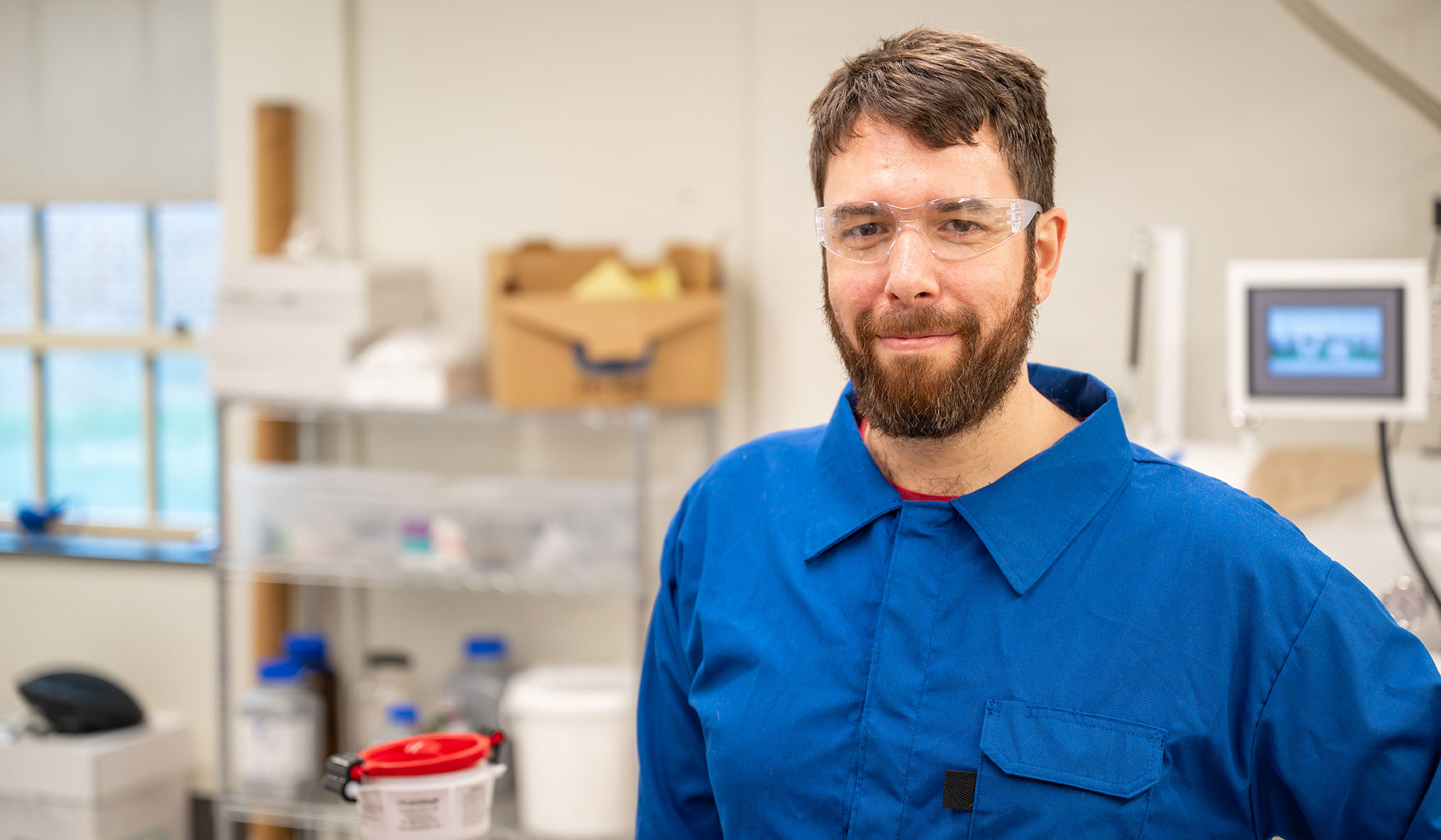
This type of technology may be possible in the future thanks to the work of Wake Forest University Assistant Professor of Chemistry Cedric Schaack and his team, who are creating the scientific building blocks for this type of discovery.
Schaack recently won an NSF CAREER Award totaling more than $687,000 over five years to study and build new polymers, or plastics, that are environmentally responsive.
“We are making plastics that can reversibly change colors. So, it can go from transparent to colored, back to transparent. We can cover the rainbow of colors, depending on what the needs are,” Schaack said. “At the same time, we’re making plastics that go from a spring shape to a flat shape and back to a spring shape. That is the core of the proposal.”
Describing himself as a fundamental scientist, Schaack says his work will help engineers, pharmaceutical companies and others create real-world applications.
“It’s a long process to go from the lab to an applied technology,” he said. “My lab will eventually hand off our discovery.”
Plastic electrical wires and shape-shifting springs
Building on their previous research, Schaack and his research team are also focused on conducting electrons and making wires out of plastic that function the same as traditional copper wires.
“We could turn them on and off like a switch, whether they conduct electricity or not,” he said. “That means we can use chemistry to change how it behaves.”
When turned on, the plastic can conduct electricity. When off, it’s simply an inactive piece of plastic.
“This is called ‘piezoelectricity.’ It’s a technology that’s already all over our lives, from medical ultrasound wands to quartz watches,” Schaack said. “Developing flexible and lightweight piezoelectrics holds promise in revolutionizing wearable health monitors, touch sensors and flexible microphones. The existing materials are based on inorganic and rare-earth elements, which are not abundant. Ours are made entirely of carbon, which is all around you, so you’re not geographically locked and there’s no risk of trade wars over the material.”
He also studies how shape-shifting springs can flatten and then return to their original shape.
“I want to understand why it forms one spring over the other and how that process happens, because that is the basis for all human life,” Schaack said. “Why is every single molecule of DNA in the entire world for every human, every animal, every anything, directional? Why do DNA and snail shells all spiral one way? So we’re hoping at least to make a foray into explaining some of that.”
Schaack is a member of Wake Forest’s Center for Functional Materials (CFM), and his work has “become an important cornerstone for our efforts in materials science,” said Timo Thonhauser, director of the center.
“Cedric’s work fits very well within CFM,” Thonhauser said. “The capabilities and interests of his research lab with regards to chiral organic systems add significantly to the strengths of CFM and allow us to broaden our scope.”
Lindsay Comstock-Ferguson, chair of Wake Forest’s chemistry department, says Schaack’s prestigious NSF award is a testament to his “bright future ahead at Wake Forest.”
“This well-deserved honor exemplifies his commitment to integrating world-class research with the education of our next generation of chemists,” she said. “We are proud to have him as a colleague.”
‘Sip-posiums’ and student researchers
Another important part of Schaack’s five-year research grant is public outreach. He plans to host “sip-posiums” at places like breweries, coffee shops and public libraries around Winston-Salem. The goal is to get scientists from Wake Forest and elsewhere to give 25-minute public talks.
“Technological advancements, many of which originated from publicly funded academic research, have enabled today’s way of life. Instead of just trying to write academic articles, why not just go and tell people what we do?” Schaack said, noting that public support is crucial to funding scientific research.
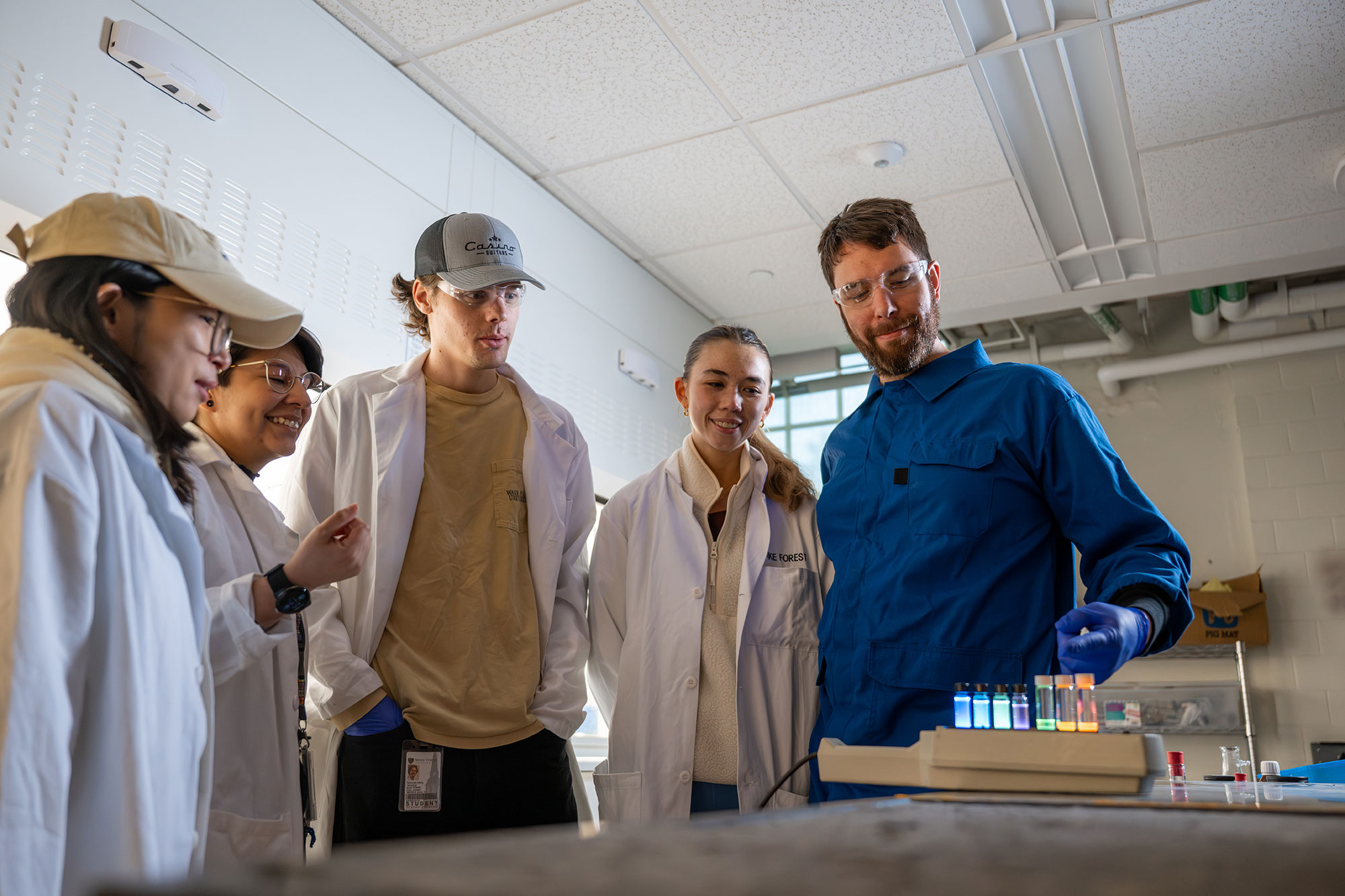
A team of graduate and undergraduate students helps bring Schaack’s research to life. They include Anna Gartner, Karla Hernandez Gomora, Max Jacobsen, Elizabeth Odom, Helene Phelan, Nicholas Woodlief and Jiaoyan Zhao.
“I’m very lucky to have wonderful students,” Schaack said. “They enjoy the research they are doing. Every time they hit a roadblock, they tackle it as an exciting challenge to overcome rather than a roadblock, and they just figure it out. Without them, the lab’s research vision would never be where it is today.”
Wake Forest University Physics Professor Oana Jurchescu credits Schaack with creating important learning opportunities for his students, whom he mentors and trains in his lab. His research will also have a major impact on next-generation light harvesting, light generation and quantum technologies.
“He has already shown success as an independent researcher, with several important and highly impactful papers published to date,” she said. “This NSF CAREER award is a powerful validation of his innovative ideas by his peers in the scientific community, and it will undoubtedly serve as a great springboard for his future work.”
— Contributed by Kelly Hinchcliffe
Recent News

Beyond the screen: Teen digital literacy and brain health
Beyond the screen: Teen digital literacy and brain health