Beyond the Field: Wake Forest and Stanford Work Together
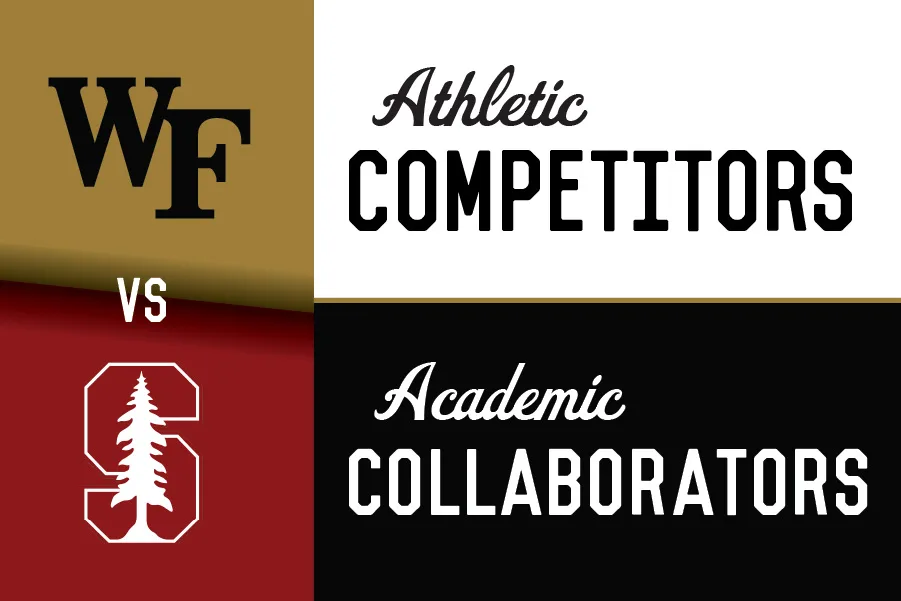
When Wake Forest hosts Stanford on Saturday, Oct. 3, thousands of fans will watch the Atlantic Coast Conference football clash.
Here is a look at four off-the-field areas where Wake Forest and Stanford focus on collaboration instead of competition.
Eyeing a major breakthrough
Scientists at Wake Forest Institute for Regenerative Medicine are working with Stanford University on groundbreaking research. Supported by up to $56 million in funding, the interdisciplinary initiative aims to achieve what was long considered scientifically impossible: successful whole-eye transplants that restore sight. By combining WFIRM’s expertise in tissue engineering and biofabrication with Stanford’s neuroscience and clinical capabilities, the team hopes to pave the way for restoring sight to millions affected by severe ocular trauma and blindness.
What happens to your body on a molecular level when you exercise?
To understand how physical activity impacts human health at the cellular level, Wake Forest’s Department of Biostatistics and Data Science is collaborating with Stanford’s Bioinformatics Center. They are part of the NIH-funded Molecular Transducers of Physical Activity (MoTrPAC), a national consortium designed to create a “molecular map” of exercise. This joint data effort aims to unlock personalized exercise prescription models that could shape the future of preventive health.
Tough conversations need a strong game plan
A $500,000 grant from Wake Forest’s Educating Character Initiative to the Intercollegiate Civil Disagreement Partnership is supporting Stanford’s McCoy Family Center for Ethics in Society as it trains student leaders to listen, handle tension and work through differences. Stanford is part of a group of six institutions that partnered on a three-year project supported by a 2025 institutional impact grant from Wake Forest.
What helps students feel like they belong?
Psychologists at Wake Forest and Stanford are studying college belonging and its effects on graduation and post-college success. The findings can help higher education leaders nationwide design institutional environments where every student can thrive. In one of their recent collaborations, the researchers looked at how the language students use in their pre-college essays could signal belonging and eventual success in college.
Recent News

Wake Forest-CINCIA researchers brief pope on Amazon mercury pollution
Wake Forest-CINCIA researchers brief pope on Amazon mercury pollution
Wake Forest graduate Chip Thomas Jr. wins prestigious MacArthur ‘Genius Grant’
Wake Forest graduate Chip Thomas Jr. wins prestigious MacArthur ‘Genius Grant’