Keeping the flu to yourself: Nudging students to isolate can pay off
New Wake Forest research points to a simple way to keep campuses healthier this winter
HIGHLIGHTS
- A Wake Forest researcher found that asking—not requiring—students to isolate when ill might reduce flu cases at universities.
- Lead author Brian Richardson applied a new method of statistical analysis to test for a causal effect.
- The findings could be used to shape public health practices during cold-and-flu season, or even future pandemics.
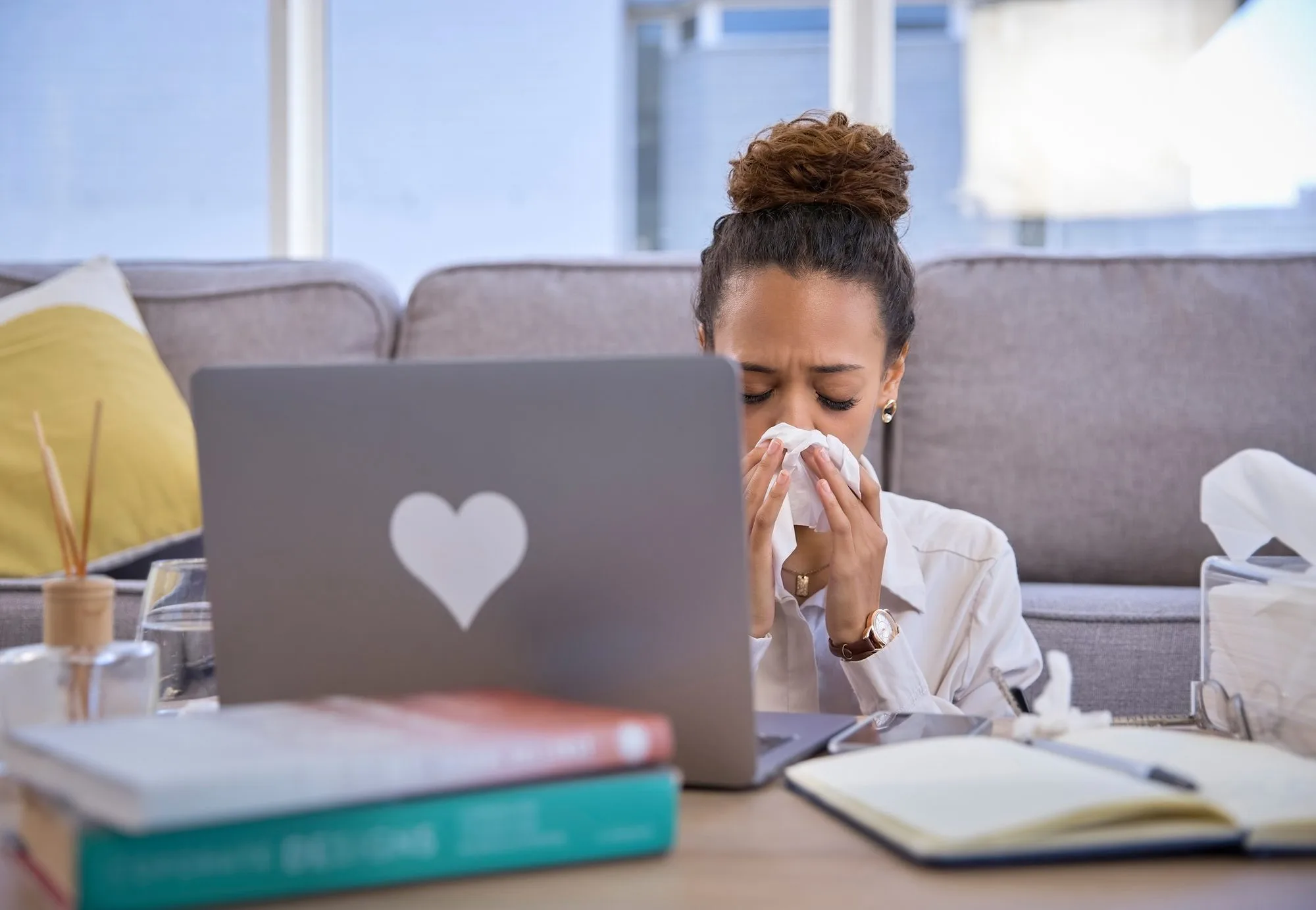
“Stay home when you’re sick”: It sounds like straightforward advice, but when it comes to college students, does it always make sense? After all, sitting alone in a dorm room can come with a steep cost—in missed classes and social isolation that together can increase stress. And how can we know it works, especially if students are advised, but not required, to isolate?

Just in time for cold and flu season, Wake Forest researcher Brian Richardson has shown that encouraging students with flu-like illnesses to isolate for three days might reduce the spread of sickness.
The findings are important because they use a new method of analysis that gets to cause and effect in controlling infectious disease. This analysis used data from what is believed to be the largest randomized trial tracking respiratory infection transmission through a social network to date.
The research also has possible implications beyond the college campus. It suggests that simply encouraging people to voluntarily isolate during an infectious disease outbreak may deliver promising results, offering an alternative to harder-to-implement public health initiatives.
Richardson, assistant professor of statistical sciences, is the principal author of the research article, which appears today in the peer-reviewed journal PNAS.
“This is something I think about all the time, as it seems like almost every day in my class, I can tell that at least one person is sick,” said Richardson, who joined Wake Forest this year. “In spite of the fact that this is an informal encouragement and students will not always follow the instructions to a T, it still appears to be effective to encourage them.”
Low-cost strategy to control spreading infections
The findings in “Physical Distancing to Prevent Influenza-Like-Illness on a College Campus: The eX-FLU Trial” have implications for public health and could shape policy on college campuses, because they show that a simple, low-cost action may keep more people healthy.
“You can imagine that in a future outbreak of respiratory illness,” Richardson said, “you could develop a new vaccine, which takes months or years, or you could implement mandatory physical distancing, which can be difficult—compared with this intervention, which just involves encouragement to isolate when sick.”
The surprise, Richardson said, was that it wasn’t easy to answer the seemingly simple question of whether encouraged isolation prevents infection. College students have a “complicated dependence structure,” or a complex social network that isn’t always predictable, he said. And it’s challenging to test for what’s known as a “spillover effect”—whether the encouragement of one student to isolate keeps other students illness-free.
Richardson’s paper applies a new kind of statistical analysis to the eX-FLU trial, which took place 10 years ago and followed college students over a 10-week period during flu season.
“We took advantage of data from a randomized experiment to test for a spillover effect even in the presence of complicated dependence,” Richardson said.
Separating coincidence from causation
The trial recruited 579 students at the beginning of flu season. Half were told to stay home for three days if they got sick, and the other half were given no instructions. Students self-reported infections and their face-to-face contacts with other students in the trial over the course of 10 weeks.
But even after the trial, getting to the scientific truth was challenging. Students weren’t forced to isolate. They naturally would not recall everyone with whom they came into contact, so the self-reporting might not be complete. And there’s a difference between correlation and causation. If flu cases dropped, how could researchers know it was the result of encouraging isolation?
To turn the study’s data into actionable information, Richardson created a new statistical testing procedure that was shown to control what’s known in statistics as the “type I error rate,” or the chance of incorrectly identifying a causal effect when one does not exist. Further, Richardson’s statistical method has promise for detecting the effect of an intervention in future, similar trials.
“My background is in causal inference for infectious diseases: how and when can you say one thing causes another?,” Richardson said. “I am concerned about a future pandemic of a respiratory illness like COVID-19. I think many of us are. One of my goals as a scientist and a statistician is to do rigorous, principled scientific research about infectious disease and communicate that effectively with the public.”
Encouraging isolation seems to work
Richardson said he’s always been interested in math. “I think it’s inherently fun and interesting to solve puzzles, and biostatistics is a way to do that for the purpose of improving human health.”
His article notes questions that future studies could consider. Could encouraging isolation periods longer than three days further reduce spread of the flu? Could you reduce infections if you only encouraged high-risk individuals to stay home?
“A future question I’m looking into is concerning the fact that we have imperfect measurements on face-to-face contact between students. Each week the students filled out a survey to report who they had contact with,” Richardson said. “I think there’s room for improvement to account for an imperfect record of face-to-face contact.”
In the meantime, Richardson said, the findings outlined in his article are useful as the winter flu season approaches. Universities, he said, “may wonder if it’s worth it to give this more informal encouragement to isolate and our answer is, we think so. It’s worth it to encourage students to isolate when sick.”
UNC-Chapel Hill researchers Allison Aiello and Michael Hudgens were the study’s principal investigator and second author, respectively. The study was funded by the Centers for Disease Control and Prevention and the National Institutes of Health.
— Contributed by Amber Veverka
Recent News

Will the new gold rush push the Amazon to its tipping point?
Will the new gold rush push the Amazon to its tipping point?