The shepherd of Robinhood Road
WFU professor’s sheep cultivate community and conversations exploring the challenges of the ‘ideal lawn’
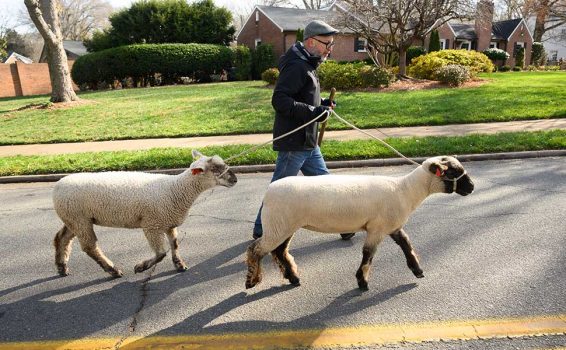
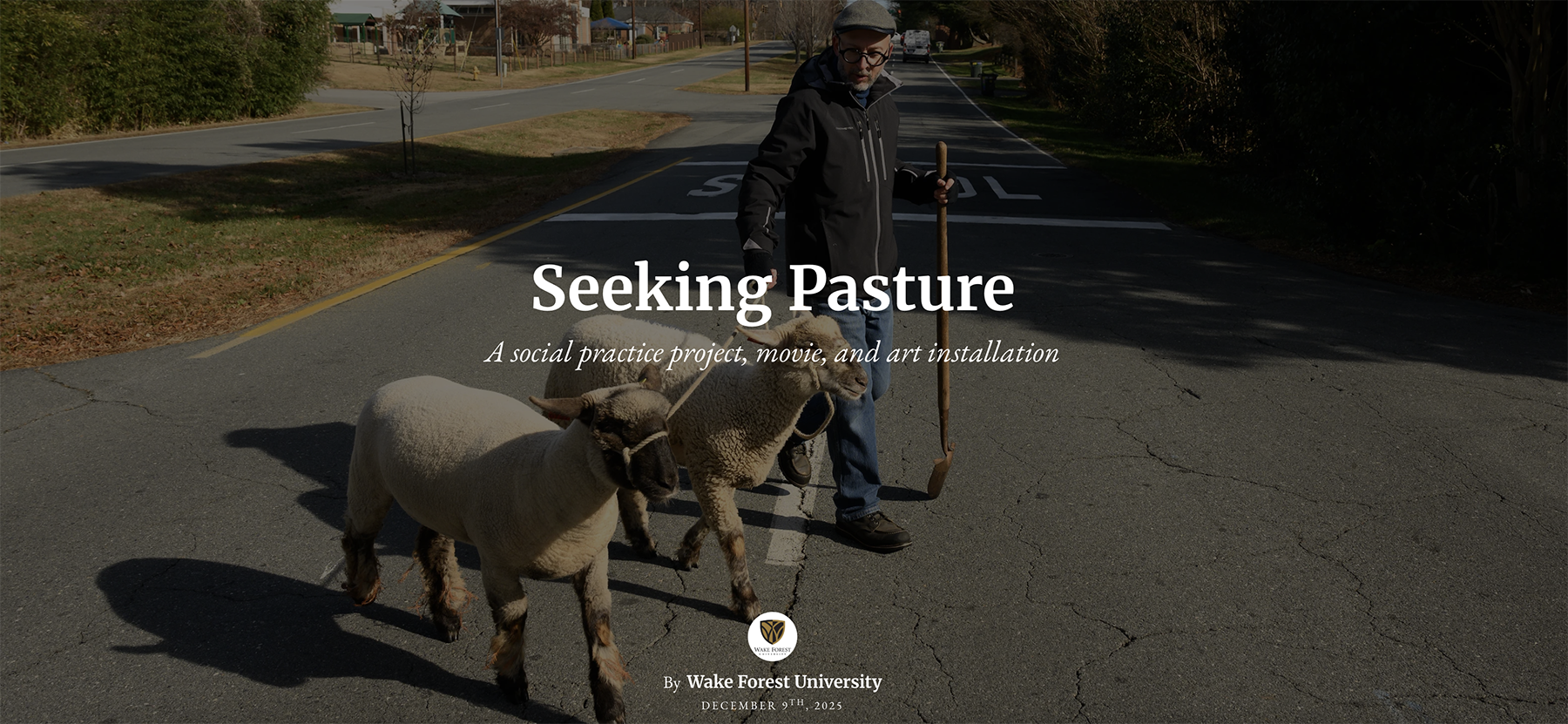
On a cold December morning in Winston-Salem, North Carolina, activist, artist and filmmaker Joel Tauber walked with Rebecca and Sarah, guiding them with a firm grip as they dashed across Robinhood Road during morning rush hour. People honked their horns and waved as they drove by, drawn by the unusual sight of two sheep on a leash.
For 40 days, professor Tauber shepherded the half sisters around his neighborhood as part of a social practice art project called “Seeking Pasture” that aims to raise awareness about community and the ecosystems we live in together. He plans to turn the project into a movie and art installation to raise further awareness about these issues.
The sheep stopped frequently on the walks, providing ample time for conversations. Neighbors came out to talk with Tauber and pet the sheep.
“You’re out one evening walking your dog, and suddenly you see this guy with two sheep and a shovel he wields like a staff, and you think, what on earth is that? Is it a man from another time? And then Joel walks right up to this neighbor, maybe a stranger, and starts talking about how the chemicals we spread on our lawns to fertilize them damage the environment and how the gas motors we use to manage our lawns also pollute the earth,” said Wake Forest English professor Eric Wilson, whose yard was one of the sheep grazing spots.
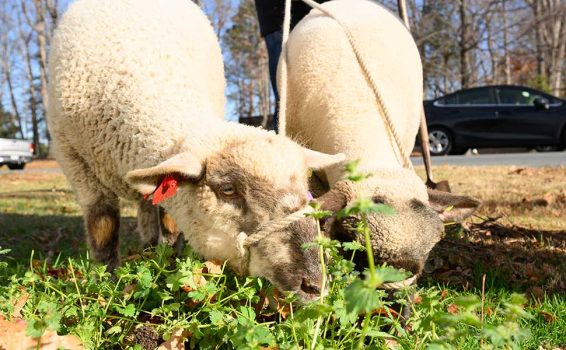
During their stay at Tauber’s home, Rebecca and Sarah grazed on 30 yards during their twice-daily strolls. They walked up to 4 miles twice a day. Each walk took between 2 and 3 hours as the sheep dined on different yards where they had been welcomed and where it was safe for them to eat.
“Keeping the sheep healthy immediately became a communal effort, because I didn’t have enough grass or land for them to eat,” Tauber said. “I had to put myself on the line, and it was terrifying. I didn’t know if the community would embrace Rebecca and Sarah.”
He asked neighbors he encountered during his walks, many of whom he had never met previously, if the sheep could eat the grass, leaves and other tasty greens growing in their yards. For the well-being of the sheep, Tauber also asked homeowners if their yards were free from harmful chemicals found in fertilizers and weed killers.
“Joel has engaged in scores of conversations over the past weeks, and he always does so with a rare blend of wit, charm and seriousness. He is truly doing the work of a shepherd – leading his sheep to sustenance – but he is also playing the shepherd more figuratively, attempting to lead us all to a greener earth,” said Wilson.
The inspiration
In 2023, the Environment America Research & Policy Center published a report based on 2020 data from the EPA, which found that gas-powered lawn equipment produced the same amount of fine particulate pollution in a year as 234 million cars and emitted more carbon dioxide than the entire city of Los Angeles.
Restrictions banning lawn mowers and leaf blowers are different across the country. Tauber’s project focuses on how recognizing the challenges and dangers of chemicals and noise pollution from lawn care may be more effective by raising awareness locally. Neighbors in cities live in close community where fertilizers, chemicals and noise in one yard affects nearby yards as well.
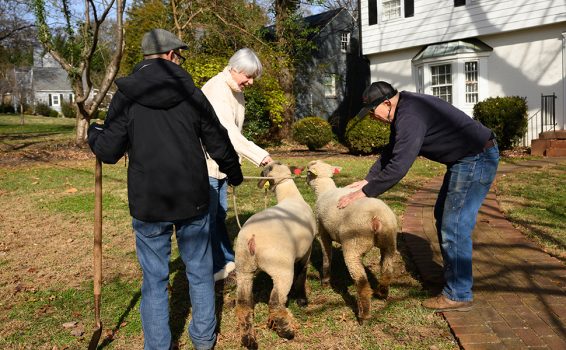
“I don’t think we are as good collectively at thinking about the community aspects of our individual choices. I was thinking about this and the leaf blowers and the chemicals, and I wondered how I could become more aware of the effects of the choices and maybe start some conversations about this with my neighbors. So, I decided to adopt two sheep.”
Taking on the care and feeding of sheep is no small task. Sheep are highly social and have strong herding instincts. They thrive on routine, dislike change and have excellent memory. They are, by nature, eco-friendly groundskeepers. In a short time, Tauber’s sheep were leading him to the lawns where they knew they could graze.
“A lot of people wanted to reach out and open their yards to Rebecca and Sarah, but couldn’t, either because they purposely or inadvertently use chemicals on their yards,” said Tauber. “I’m far from perfect. We use a lawnmower, but pollution in our city, for such a small city, is significant, and it’s always bothering me.”
Student engagement
Sophomore Nate Nail, who is planning to study both environmental science and film, volunteered as an assistant to work on Tauber’s project.
Nail had enrolled in a class on ecological works and video art, where Tauber shared with the students that he would be on sabbatical for a year. He offered those in his class an opportunity to gain hands-on experience by assisting him with a filmmaking project.
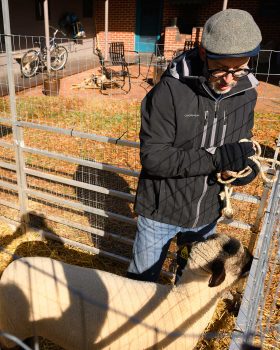
“I had no idea what to expect, and then all of a sudden, there’s this big pen in professor Tauber’s backyard with two sheep,” Nail said. After Tauber explained the project, the filming support became clear. Nail would, with fellow WFU student Tavis Conway—as well as with longtime professional cinematographer Amit Bhattacharya and new sound recordist Max Smith—film how Rebecca and Sarah brought neighbors together for conversations on the environmental challenges of sustaining picture-perfect lawns.
“Professor Tauber is inspiring,” Nail said. “He emphasizes in his classes the importance of focusing on the action of filming. …I’ve learned that you have to take some risks and just do things, and I saw it firsthand.”
For several weeks, Nail spent Saturdays learning film techniques and helping to capture Tauber, Rebecca, and Sarah, as well as the opportunities for conversation they created. “As I worked with professor Tauber, I saw him talk to so many people on his daily walks. I saw people taking photos, people asking him about the sheep and his project, and I saw that it was impactful.”
After 40 days of grazing in residential yards, Rebecca and Sarah have moved on to more traditional pastures. The pair have been adopted by Crossnore Communities for Winston-Salem Children, where the twosome are enjoying making new friends with other animals and children at the community’s farm.
About Joel Tauber
Art professor Tauber is an affiliate faculty member with Wake Forest University’s Sabin Center for Environment and Sustainability. The “Seeking Pasture” project is a form of creative environmental research that aligns with the Center’s mission to foster interdisciplinary action and dialogue on sustainability. His internationally recognized social practice art project, movie and art installation Border-Ball, also aimed to create connection and community in divided times.
Visit Joel Tauber’s website to see all of his projects.
To view the Seeking Pasture photostory, click below.
Categories: Arts & Culture, Environment & Sustainability
Media Contact
Kim McGrath
media@wfu.edu
336.758.5237
Recent News