Wake Forest physicist Caitlin Witt receives NSF grant to search for ripples in spacetime
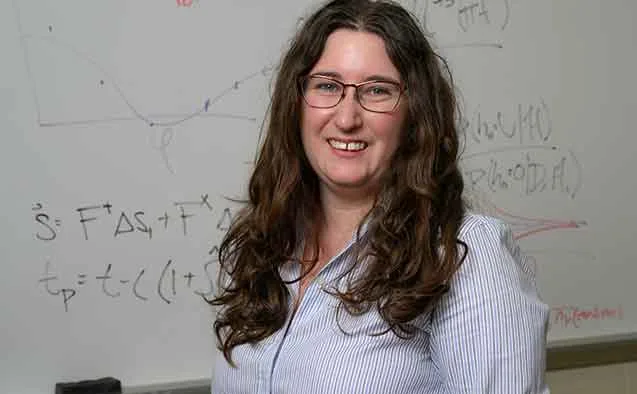
Wake Forest University physics department Assistant Professor Caitlin Witt has received a National Science Foundation (NSF) grant that will help her and her team of students study ripples in spacetime known as gravitational waves as part of the North American Nanohertz Observatory for Gravitational Waves (NANOGrav). This international collaboration searches for gravitational waves to better understand the origins of our universe.
The grant is part of an NSF 18-month, $5.9 million award to 19 institutions across North America. The funding will allow for travel and greater flexibility in how students can be involved in the research, Witt said. “The opportunity for student collaboration is truly a unique opportunity.”
NANOGrav’s window to the cosmos
Just as different types of telescopes observe different types of light, there are different methods to detect gravitational waves. Ground-based instruments like the Laser Interferometer Gravitational-wave Observatory (LIGO) detect high-frequency gravitational waves from the collisions of stellar-mass black holes and neutron stars. Within the decade, NASA plans to launch a laser interferometer gravitational wave observatory into space – the Laser Interferometer Space Observatory (LISA) mission.
NANOGrav searches for low-frequency gravitational waves that could come from pairs of supermassive black holes orbiting each other in the aftermath of galaxy collisions. These gravitational waves could also be leftover echoes from moments after the Big Bang or come from the rippling of theoretical “cracks” in the universe called cosmic strings. Gravitational waves are ripples in space caused when black holes or dense stars collide.
“These low-frequency gravitational waves are really, really big. They’re actually too big – too long of a wavelength – to be ‘seen’ by a gravitational wave detector that exists on Earth,” Witt explained. The time between the start of one wave and the start of the next can take months to decades, she said.
Measuring massive waves
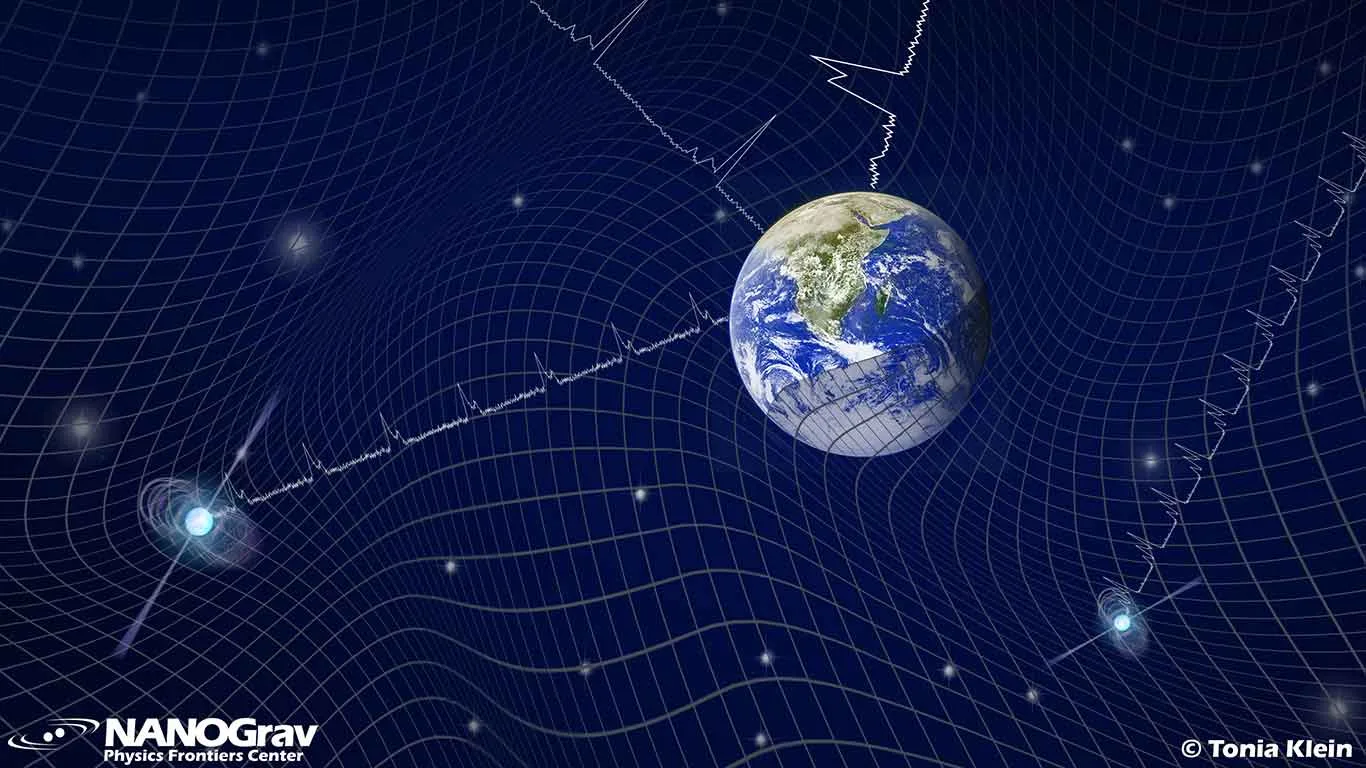
To measure these massive waves, NANOGrav’s researchers use a galaxy-sized detector of dense, rapidly rotating dead stars called pulsars. These special celestial bodies can spin hundreds of times per second, sending out pulses of radio waves like a lighthouse and acting as highly precise celestial clocks. NANOGrav scientists observe an array of these pulsars over time.
“We can time precisely how fast they spin,” Witt said. “This means, if you affect the gravity where the pulsar is and then where the Earth is, we can see by how the light changes—by how it passes from the pulsar to the Earth—that something is changing with the surface of the space-time, either here or at the pulsar. That’s how we detect the gravitational waves.
“But the pulsars are all very different distances from Earth, so we end up learning about the gravitational waves at different points along their lifespan,” said Witt, adding that this research is a “long game that we need to play to observe for as long as possible to see them and see these subtle changes.”
Student research opportunities
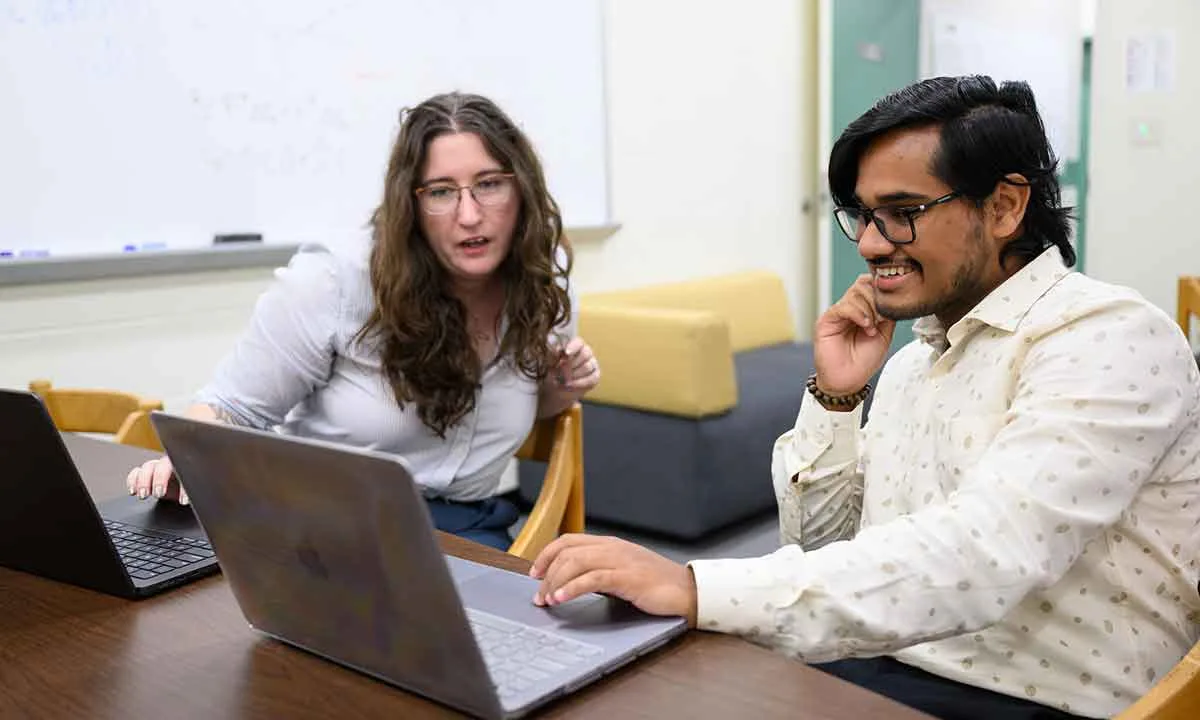
The grant will enable Witt and her students to work with NANOGrav researchers to help finish creating and analyzing NANOGrav’s 20-year data set, allowing scientists to look for gravitational waves that take up to 20 years to repeat.
Scientists observe pulsars using some of the largest radio telescopes on Earth at the Green Bank Observatory in West Virginia, the National Radio Astronomy Observatory’s Very Large Array in New Mexico, and CHIME, a major radio telescope at the Dominion Radio Astrophysical Observatory in Canada. The data is then processed and shared with Witt and other researchers for analysis.
“There are observations nearly every day or every few days of the different pulsars in the array. There are 75 of them that we observe now,” Witt said, noting that NANOGrav welcomes student observers and she hopes some of her students will participate.
This research “is painting the bigger picture,” Witt said. “It could tell us about what will happen to our galaxy in the future, what that will mean for our planet and our lives here. But that’s way in the future. A little closer to home, this gives us a really neat technique for developing some wonderful technology. And also train some spectacular students.”
— Contributed by Elaine Ellis
Recent News
Why do we see ghosts? The science behind spooky encounters
Why do we see ghosts? The science behind spooky encounters
Beyond the Field: Wake Forest and UVA Work Together
Beyond the Field: Wake Forest and UVA Work Together