Wake Forest-CINCIA researchers brief pope on Amazon mercury pollution
Scientists travel to the Vatican to share findings during audience with Leo XIV
HIGHLIGHTS
- Scientists briefed the pope on mercury pollution from gold mining in the Amazon forest.
- The toxic mercury travels through ecosystems, harming wildlife and Indigenous communities.
- Research from CINCIA and Wake Forest will inform the pope’s visit to Peru in November.
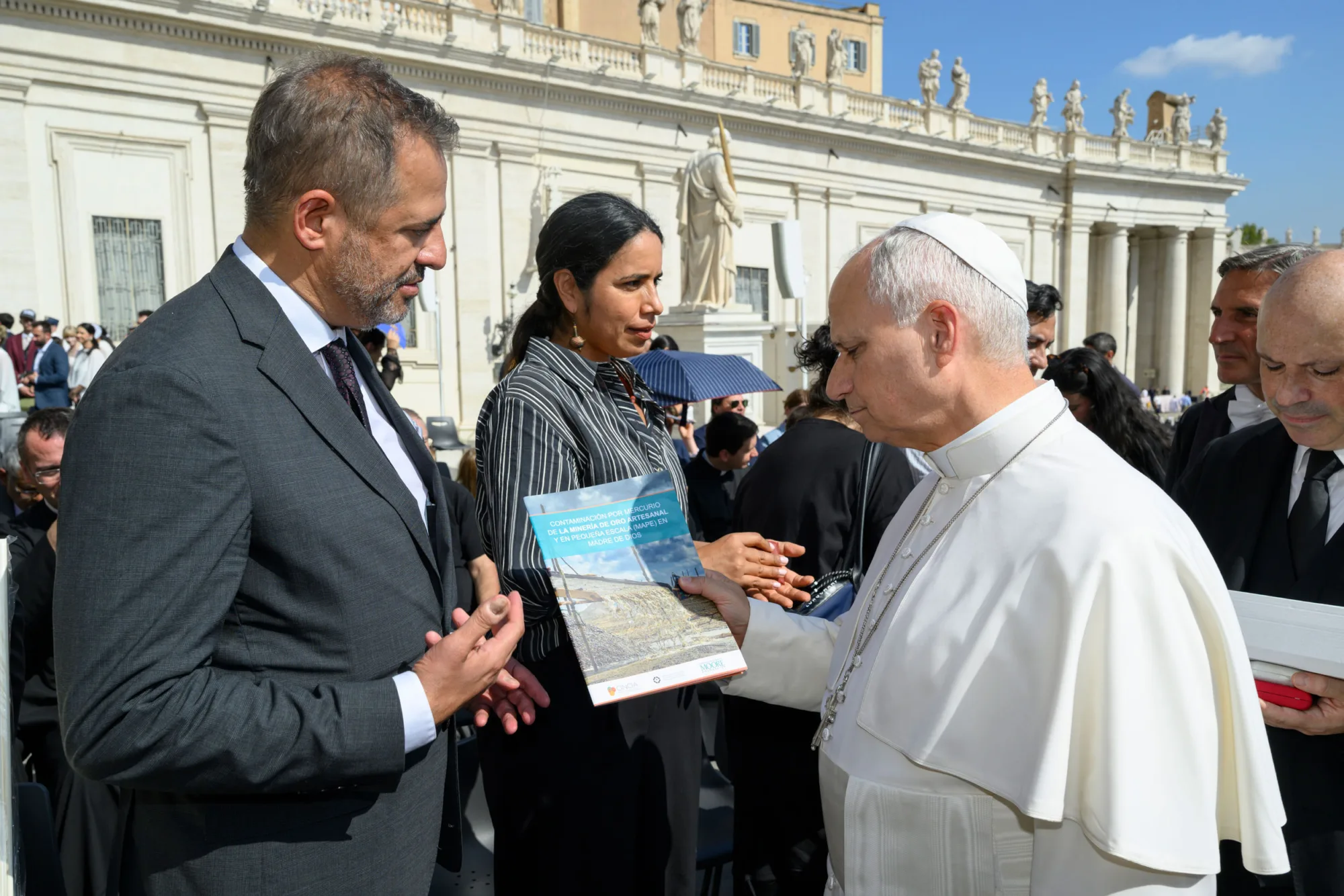
Scientists from across the Amazon have delivered to Pope Leo XIV a briefing on mercury pollution in the region—documents that include the findings from decades of research at the Center for Amazonian Scientific Innovation (CINCIA), established in partnership with Wake Forest University’s Sabin Center for Environment and Sustainability.
“Today we were able to put more than a decade of Wake Forest and CINCIA-led scientific evidence on mercury contamination in the Amazon directly into the hands of the pope,” said Luis Fernandez, Wake Forest research professor of biology, senior fellow with the Sabin Center, and co-founder of CINCIA. “That evidence shows that mercury associated with gold mining does not stay at the mine—it moves through ecosystems and ultimately reaches people, including some of the Amazon’s most vulnerable Indigenous communities.”
Fernandez and Claudia Vega, Sabin Center fellow, CINCIA mercury program coordinator and TED Fellow, traveled to the Vatican on Sept. 30 to brief Pope Leo on the mercury contamination crisis, along with Jesús Olivero-Verbel of the University of Cartagena, Colombia, and Oscar Campanini, executive director of the Center for Information and Documentation-Bolivia.
These researchers presented the pontiff with a brief that showed evidence of the mercury contamination wrought by gold mining across Peru, Bolivia, Brazil and Colombia.
“One of the most important roles of science here is to make invisible damage visible,” said Fernandez, who delivered the CINCIA/Wake Forest brief directly to the pontiff. “Mercury doesn’t stay where the gold is mined. It can move through the air, soils, rivers and food webs, accumulate in fish and wildlife and ultimately reach people, including Indigenous communities that may live far from the mining itself.”
The audience with Pope Leo comes amid a series of events centered around the Vatican’s increasingly vocal stance on caring for the planet.
The brief will help inform the pope’s Nov. 15 visit to Peru, where he will meet with missionaries and representatives of the Amazonian peoples.
And it shows that the mercury pollution and other persistent environmental destruction caused by artisanal and small-scale gold mining is no longer a niche issue but an urgent global one, Fernandez said.
Ambitious, influential Sabin Center project
An initiative based in the Madre de Dios region of the Peruvian Amazon, CINCIA supports projects that focus on scientific research, ecosystem restoration, education and sustainability. Innovative partnerships with local residents, researchers and governments are key to CINCIA’s mission, which aims to develop conservation solutions through science.
Sabin Center leaders call CINCIA its most ambitious and influential project—an effort to learn from and preserve one of the most biodiverse places on earth.
“This is an extraordinary moment, honestly, one that clearly shows the global importance and groundbreaking nature of the work done by those tied to the Sabin Center and CINCIA.”
Alan Townsend, executive director of the Sabin Center
“Science is essential to a healthy planet and the people who call it home, but getting the answers we need often takes years of very difficult, sometimes very brave work,” Townsend said. “The Sabin-CINCIA collaboration is a shining example of that.”
Miles Silman, Andrew Sabin Presidential Chair of Conservation Biology at Wake Forest and president of the CINCIA Board of Directors, studies how mercury pollution has affected the rainforest as well as how trees might adapt to rising temperatures in the Amazon. His work also focuses on training the next generation of scientists in the Amazon and throughout the developing world.
“The continued engagement with Pope Leo and Pope Francis before him is a testament to the importance and reach the work in Peru has, and how broad and effective Wake Forest, the Sabin Center, and the ethos of Pro Humanitate are,” Silman said.
Using science to protect God’s creation
Since elected in 2025, Pope Leo has remained vocal about his support for the environment. In early September, the Vatican released “Caring for Our Common Home,” a document that calls for all people to protect the planet as God’s creation. Just before CINCIA’s audience, the Pontifical Academy of Scientists met to discuss “The Future of Science in a Changing World.”
Pope Leo’s interest in Peru stems from the more than two decades he spent in that country as a missionary, educator and bishop of the Diocese of Chiclayo.
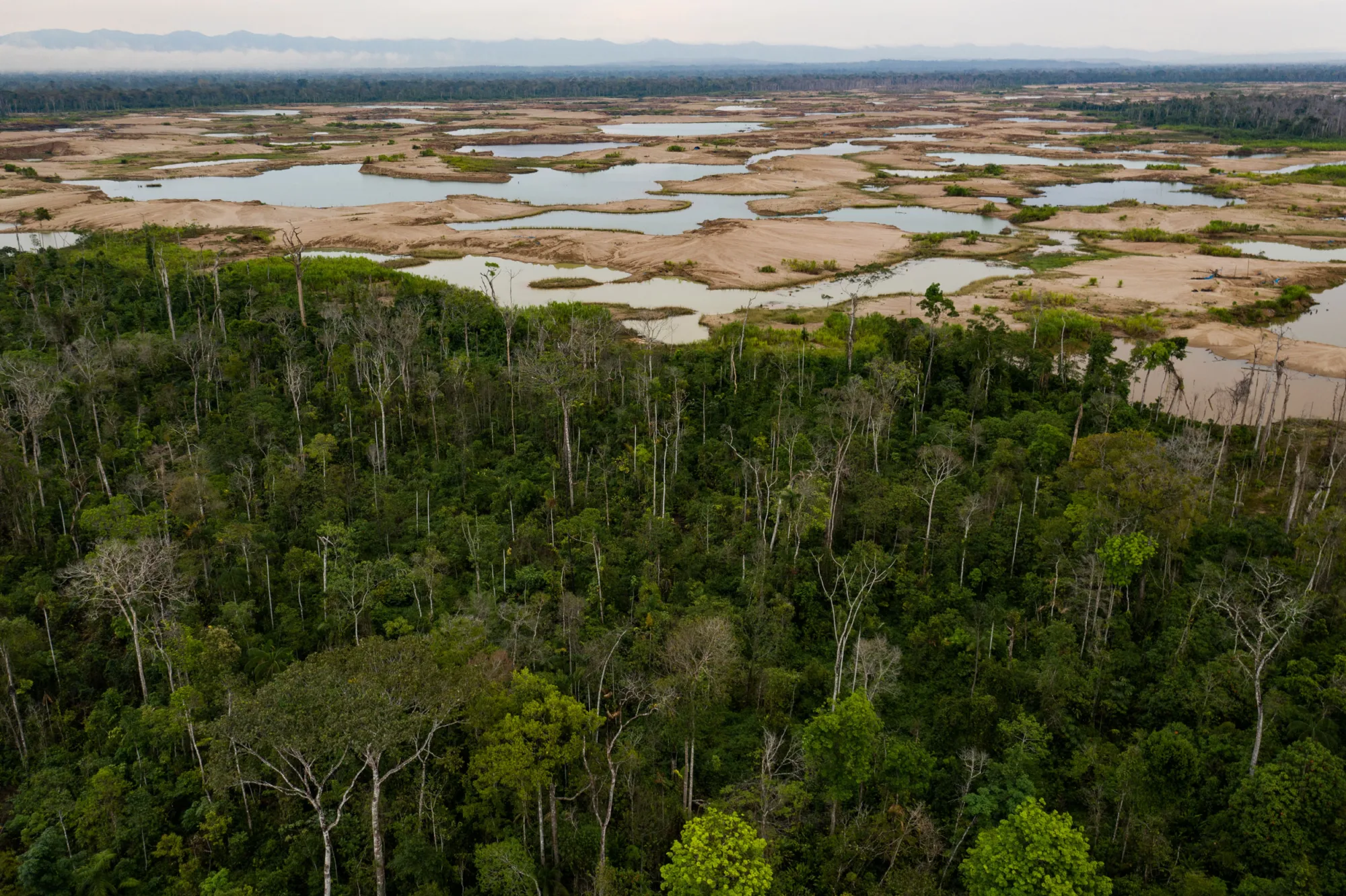
Some of CINCIA’s most high-profile work has centered on the mercury contamination caused by artisanal, small-scale gold mining in the Amazon. The practice has turned large swaths of lush forest into barren acres of sand dunes pockmarked by ponds filled with mercury-contaminated water.
Widespread threat to the rainforest, humans
CINCIA’s scientists do more than study the growing mercury pollution problem in the Amazon. They train the next generation of local environmental scientists to assess pollution in the water and on land. And they help local people amass scientific evidence to inform policymaking at all levels of government.
Vega calls the mercury pollution in the Amazon one of the area’s most widespread threats to the rainforest and human health. During the Sept. 30 audience, she presented the pope with a traditional Indigenous textile made by a Yine artist from Madre de Dios.
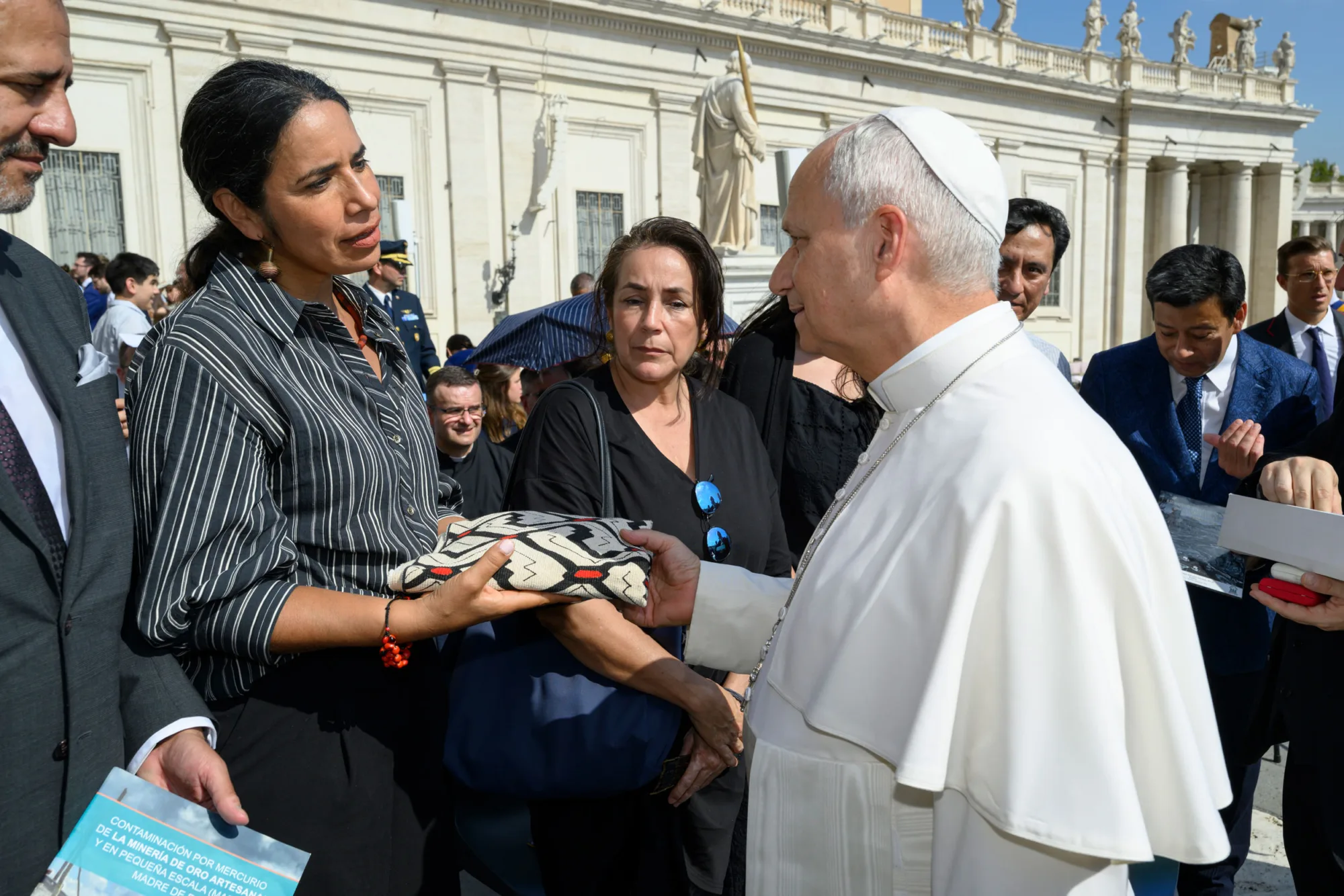
The gift, she said, represents the people, culture and future generations of the Amazon, and what is increasingly at risk as gold mining expands and mercury contamination affects rivers, ecosystems and communities.
“For more than a decade, Wake Forest, CINCIA and our partners have been documenting mercury contamination in Madre de Dios and other parts of the Peruvian Amazon, in air, soils, sediments, fish, birds, bats and people,” Vega said. “The point isn’t simply to measure contamination. It’s to generate evidence that can guide health protection, monitoring, better regulation, safer food choices, and ultimately reduce the amount of mercury entering these ecosystems in the first place.”
This isn’t the first pope to take an interest in CINCIA’s work. In 2018, Pope Francis visited Puerto Maldonado in Madre de Dios to highlight the devastation of the tropical rainforest and champion the rights of the Indigenous people who have suffered from the mercury pollution. The science conducted by Wake Forest and CINCIA on mercury contamination was included in a document the pope used to prepare for the trip.
Ultimately, CINCIA’s goal is to prevent additional mercury from entering Amazonian ecosystems, reduce exposure among wildlife and people who are already at risk from this toxic pollution, and give communities and decision-makers the information they need to act.
Fernandez said that means monitoring mercury in the environment and in people, identifying the highest-risk areas and populations, improving conservation and public-health responses, helping move gold production away from mercury, and strengthening the systems that keep illegally produced gold and mercury moving through the economy.
Success, he said, means healthier communities and ecosystems and much less mercury being released into the Amazon.
About the Sabin Center
- Brings together over 100 faculty and fellows across disciplines including the sciences, law, business and humanities to tackle pressing environmental issues.
- Supports research and projects ranging from local initiatives in North Carolina to broad conservation efforts in the Peruvian Amazon.
- Launched CINCIA in 2016 to develop transformative solutions to promote sustainable use of tropical landscapes, combat environmental destruction and improve human health in the Peruvian Amazon.
- Established in 2010 as the Center for Energy, Environment and Sustainability, and reestablished in 2023 following a $5 million gift from the Andrew Sabin Family Foundation.
About CINCIA
- Supports research on mercury pollution in water and soil ecosystems, reforestation, drone analysis of artisanal and small-scale gold-mining sites, and outreach and education with a vast network of local partners.
- Built Peru’s first dedicated environmental mercury chemistry lab.
- Established on Earth Day, April 22, 2016.
Categories: Environment & Sustainability, Research & Discovery
Media Contact
Alicia Roberts
336.758.5237
Recent News
Wake Forest graduate Chip Thomas Jr. wins prestigious MacArthur ‘Genius Grant’
Wake Forest graduate Chip Thomas Jr. wins prestigious MacArthur ‘Genius Grant’
Wake Forest University and Allegacy Financial announce renewed and expanded University-wide strategic partnership
Wake Forest University and Allegacy Financial announce renewed and expanded University-wide strategic partnership