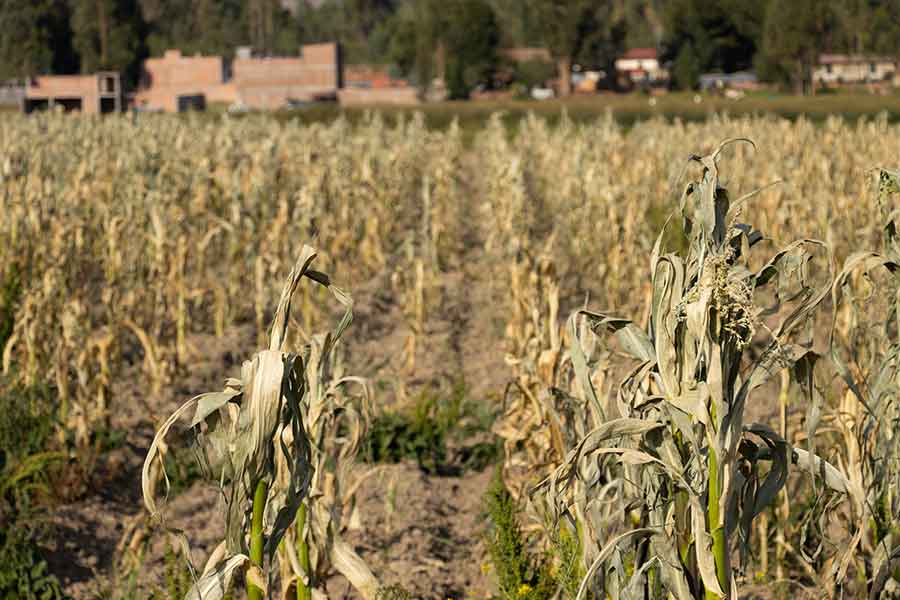
Tropical trees are fighting an uphill battle with climate change. And they’re losing.
When William Farfan-Rios hikes through the remote forests of the Peruvian Amazon and Andes, he’s doing much more than feeding his appreciation for the natural world. He’s trying to identify the trees that can survive a warming climate—and, ultimately, save one of the world’s largest carbon sinks from collapse.
As a biodiversity fellow in forest ecosystems at Wake Forest University’s Sabin Center for Environment and Sustainability, Farfan-Rios studies how trees in the Andes-Amazon region might adapt to climate change by moving uphill. A native of Cusco, Peru, Farfan-Rios found his research passion as an undergraduate student, assisting with forest plotting and monitoring conducted by the Andes Biodiversity and Ecosystem Research Group (ABERG). As a graduate student, he studied with Miles Silman, Andrew Sabin Family Foundation Professor of Conservation Biology at Wake Forest and ABERG co-founder.
ABERG maintains dozens of forest plots ranging in elevation from the Amazon lowlands to 3,700 meters in the Andes Mountains, providing a living lab for Farfan-Rios’ research. With his most recent research study, he expected to find warm-adapted trees migrating to higher elevations. But he discovered that environmental warming is happening faster than those trees can adapt.
What is unique about this large tract of forest that you study in Peru? Why do you study it?
We have this long-standing elevational gradient and, to my knowledge, it’s one of the longest on Earth. It’s estimated that the Amazon harbors around 16,000 tree species. In our transect, in our last study, we documented around 2,500 species.
The transect spans 3,500 meters in elevational range, from the lowland Amazonian forest at around a hundred meters to the Andean tree line at around 3,700 meters. You can see how the system is transitioning; this gradual change in species of plants, in the forest structure, is noticeable once you go up to the gradient. It’s so fascinating to see how even just the leaf size and how thick the leaves are change with the gradient.
Wake Forest and ABERG and the Sabin Center, they’ve been keeping these transects. These elevational transects are natural laboratories. They are there so we can study how they function and how they respond to global change.
How do you track the growth and movement of trees? What is the scientific process?
We go to the forest with a machete and a compass and we mark our one-hectare plot, then measure the diameter of the trees. Then we collect leaf samples using telescopic pruners. We preserve those samples and send them to our lab in Cusco for identification.
We have been working with the adult trees, trees above 10 centimeters in diameter, almost the size of a wine bottle. We usually go back to the forest every two to four years to see how those trees are growing or dying, and, if they’re surviving, how they’re surviving. Once our fieldwork is complete, we clean and standardize our dataset, we then use advanced statistical models to assess how species are shifting in response to warming.
But the question now is what about the seedlings, saplings or juveniles? We are going to survey the juvenile trees because they’re going to be the future generation, the future composition of the forest. If we can link how these juveniles are doing with what the adults are doing, we will have a better understanding of the forest’s responses to global change. So far, we are working at a community level, but communities are made of species, and finding which species are doing better in their current environment will help us to better understand how we can use them to protect the forest.
We did some preliminary analysis and we found that fast-growing species may be the ones that are adapting better to these novel environments.
When we perform our research, we think that the end goal is to publish a manuscript and to get a grant, but we are learning that’s not the end. The end is to actually commit the results to the decision makers, so we can work together on the best strategies to maintain the forest. With ABERG, we do workshops, training and field campaigns with people who make decisions, like directors of national parks. We have workshops with regional governments so they can improve the policy to protect these natural resources.
Thermophilization is an intimidating word, but it means a lot for the survival of trees facing climate change. How does this process work?
One way to assess the impacts of global change in the tropical forest is testing the thermophilization hypothesis.
We have species that are more adapted to warm climates and species that are adapted to cold climates. Under the current climate warming, we expect that those species adapted to warm climates will increase in relative abundance. That is the thermophilization process.
After 40 years of forest monitoring in the Peruvian elevational transect run by ABERG and the Bolivian elevational transect run by the Missouri Botanical Garden, we found that the average thermophilization process was an order of magnitude slower than the current regional warming rates. We were not expecting this. We basically found that these forests are not adapting fast enough.
Dispersion is one of the key factors for trees to expand or contract their ranges in an elevational gradient. Trees use animals or wind to disperse the seeds. But that strategy takes time.
Beyond immediate species loss, what are the global consequences of the forest’s failure to adapt? How does it affect us in the United States?
Here in Winston-Salem, we wonder how important is the Amazon for us? The Amazon plays a big role in regulating the climate and the carbon cycle. The Amazon is storing all this carbon, not just above ground in the trees, but also below ground. There is a big amount of carbon reserves in the soils of the Amazon. If we release this with deforestation, with mining, we’re releasing all this carbon into the atmosphere, impacting or increasing global change. Actions that we’re doing here, they have an impact in the Amazon, and what’s happening in the Amazon has an impact here in Winston-Salem.
If we go down to the Amazon, we see these illegal mining places. They look like a desert. Before it used to be covered with a green, beautiful forest. But what the mining is doing, they remove the trees but also they remove everything in the soil, all the microorganisms, all the interactions between soil and plants. We are having loss in diversity, loss in function of the forest. And then the challenge is how do we recover those systems? How do we actually regrow those systems? That’s one of the sites that we’re working to improve.
Is there a point of no return? Why can’t we just plant more trees?
Trees are long-lived organisms, and time is critical for them. Trees in the Amazon and Andes, some are over 500 years old. One of the critical things for them to adapt, to move, is absolutely time. There’s evidence that we had climate change in the past, but the rates were really slow. Now, warming is happening too fast for the trees to track it. They will have to acclimatize, changing some functional traits, like increasing the size of the leaves so they can do better photosynthesis or finding really cold micro-climates they can use as a refuge.
When trees reach the thermal tipping point, the photosynthesis pathway is going to break and the trees will start dying. Maybe we’re seeing that, but we need to test for this.
Survivorship is low when you are a seedling. A tree can be one centimeter in diameter and more than 50 years old.
Once we identify those trees that are the winners in adapting to these novel environments, we can understand better their natural history and maybe we can use them to facilitate the upslope migration or reforestation campaigns in places where we’re losing forest cover.
We need to save forests because they are a really important component of regulation of the climate, regulation of the water cycle, regulation of the carbon cycle. And if we disrupt the dynamics, the function in this forest, we will be the ones who suffer the consequences.
Recent News
Professor wins award to study color-changing plastic and shape-shifting springs
Professor wins award to study color-changing plastic and shape-shifting springs
Beyond the screen: Digital literacy and brain health
Beyond the screen: Digital literacy and brain health