Wake Forest receives $5 million to expand the role of character-based leadership in legal education
The grant from the Kern Family Foundation will enable the Wake Forest University School of Law and the Program for Leadership and Character to sustain campus-based initiatives while also paving the way for a network of law schools committed to leadership and character in the law.

The Wake Forest University School of Law and the Program for Leadership and Character have announced a new $5 million grant from the Kern Family Foundation to continue and expand the role of character in legal education on campus and beyond. The grant, “Leadership and Character in the Law: From Wake Forest to the World,” will continue the Program’s efforts with Wake Forest Law faculty, staff, and students through 2029. The funding will also help Wake Forest move toward the creation of a network of law schools interested in prioritizing character-based leadership and professional identity formation.

“The Kern Family Foundation’s gift not only recognizes the Law School’s commitment to professional identity formation through our numerous programs and initiatives—like our Leadership & Character in the law student cohort—it also aligns with our long-standing core values,” says Andrew Klein, dean of the Wake Forest University School of Law.
“At Wake Forest Law, Pro Humanitate underscores everything we do, and this generous gift will allow us to continue embedding those values into the fabric of how we educate our students.”
Andrew Klein – Dean of the Wake Forest University School of Law
“Lawyers provide vital counsel to individuals, families, communities, and institutions at key decision making and inflection points,” says James C. Rahn, president of the Kern Family Foundation. “It is essential for lawyers themselves and their counsel to be anchored in truth, rooted in character, and tempered via practical wisdom. This is key to a healthy civil society. The Foundation is pleased that Wake Forest will take the lead in establishing a network of law schools committed to these ideals.”
The funding comes at a time when character-based leadership in legal education is more important and relevant than ever. In 2022, the American Bar Association updated its accreditation standard to require law schools to “provide substantial opportunities to students for … the development of a professional identity.” The NextGen Bar Exam, which will be administered for the first time later this year, will rely less on memorization of facts and more on applying knowledge and skills to complex legal and ethical scenarios. It will also assess students’ ability to negotiate, resolve disputes, and manage client relationships.
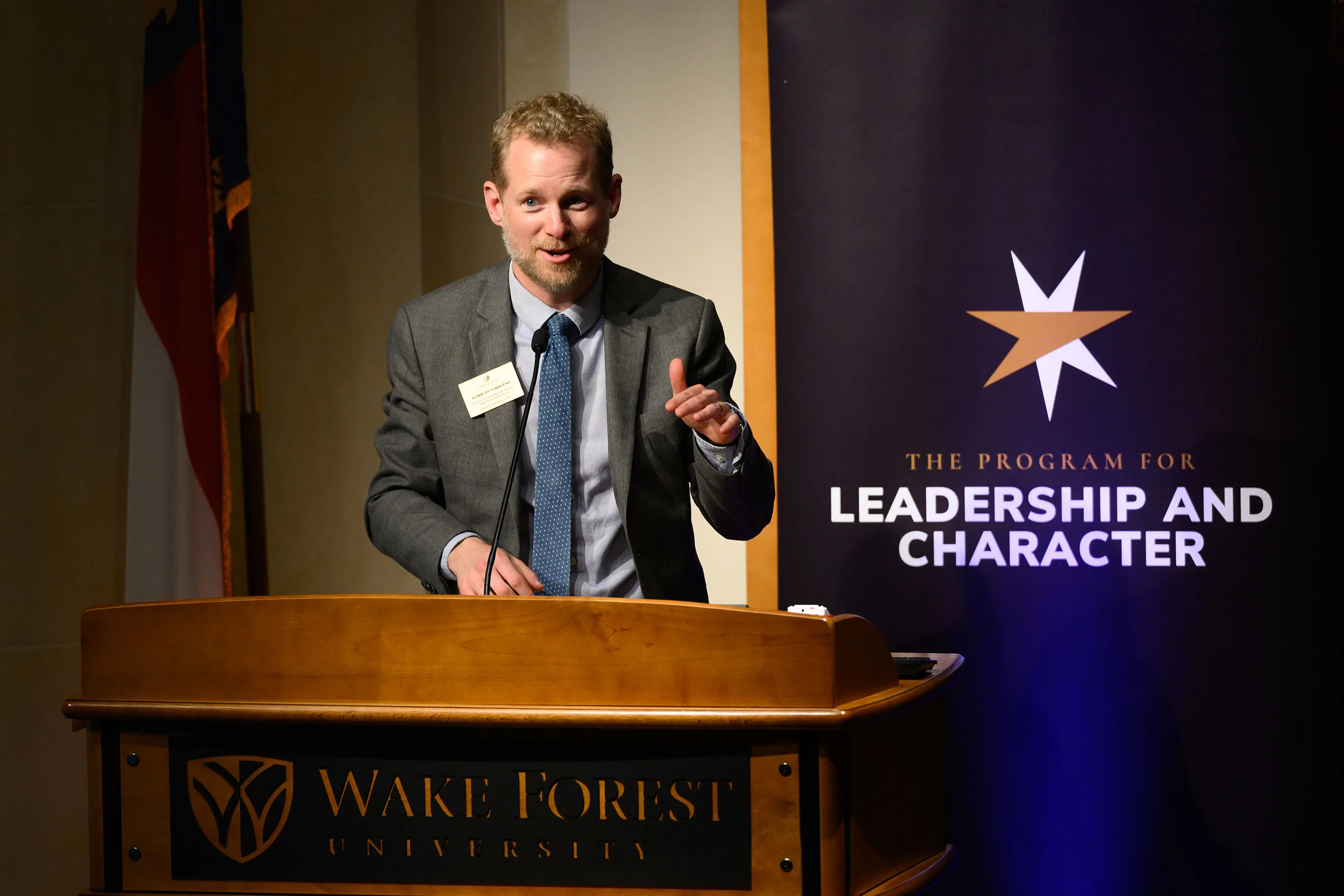
At the same time, law students and lawyers face increasing pressures, including a loss of trust in the profession; demands to specialize; mental health challenges; and disruption by new technologies like artificial intelligence. Legal education is beginning to move toward change. “A movement is afoot, and reform is underway,” says Kenneth Townsend, Executive Director of Leadership and Character in the Professional Schools and a teaching professor in the School of Law. “The moment calls for institutions like Wake Forest to ensure character is central to those reforms.”
Wake Forest deepened its commitment to character-based education with the founding of the Program for Leadership and Character in 2017, built upon the longstanding research and efforts of educators across campus and infused by the university’s Pro Humanitate ethos. Townsend’s arrival in 2019 marked an expansion into the Law School, which was further enhanced by a grant awarded by the Kern Family Foundation in 2021. That funding helped spark student programming, faculty development, curricular design, research and assessment, and external engagement.
The effects over the past three-and-a-half years have been transformative. All incoming law students now participate in four 75-minute sessions focused on purpose, intellectual humility, trust, and resilience during new student orientation. The Leadership and Character in the Law Cohort selects 15 students to take part in an intensive series of workshops, discussions, and modules on character-based leadership led by Dr. Benjamin Rigney.
In addition, Dr. Nancy Winfrey, Assistant Director of Curriculum and Pedagogy in the Professional Schools, works closely with law faculty on curriculum and support, and more law faculty have participated in the Program’s summer course development and redesign workshops than any department or school on campus. The resulting 13 new or redesigned classes have reached more than 500 students.
The Law School has also held more than a dozen character-based workshops for students and, in collaboration with the Legal Writing Institute, has hosted two Clerkship Colleges, training current and prospective judicial clerks focused on principles of leadership and legal writing skills. In March 2025, the Program hosted its inaugural “Leadership and Character in the Law” conference, co-hosted by the Law School and the Association of American Law Schools (AALS). Over the last two years, a number of law firms and professional associations have invited Program leaders to deliver presentations and workshops, which have reached more than 2,500 lawyers.
The new funding from the Kern Family Foundation will allow Wake Forest Law to build on those successes at Wake Forest while reaching beyond campus to inspire other institutions to place character at the center of leadership in the law. “We’re hopeful that this effort will support character-based leadership in legal education and the larger culture that it shapes, particularly given how many lawyers serve in influential roles in business, politics, and technology development,” says Townsend.
Initially, the Program and the Law School will share resources and learning opportunities like webinars, and host in-person convenings like workshops and an annual conference. These efforts will pave the way for a more formal network of law schools and educators to foster character-based leadership in legal education across the country. “We are grateful to the Kern Family Foundation for this significant contribution,” says Klein. “I look forward to expanding our professional identity work, and serving as a model for other law schools who seek to integrate leadership and character initiatives into their institutions.”
Recent News

Celebrating 20 years of undergraduate research and discovery
Celebrating 20 years of undergraduate research and discovery
What the neuroscience of motivation has to say about GLP-1 drugs
What the neuroscience of motivation has to say about GLP-1 drugs