A top marathoner needs science to win big. He comes to Wake Forest for testing.

HIGHLIGHTS
- Without access to performance testing in his home country, elite marathoner John Korir sought help from Wake Forest researchers.
- Health and Exercise Science Professor Peter Brubaker convened a group of University experts to devise a plan.
- School of Business alums Emily and Keith Davis, owners of local Fleet Feet, made the connection.
When John Korir hit the rust-red track at Wake Forest University’s Kentner Stadium on a recent steamy summer afternoon, he needed to know one thing: Could he somehow tailor his training to boost his performance by 1%?
Ranked the fifth-fastest marathoner in the world, Korir wants to break a record this year. He turned to researchers in the Department of Health and Exercise Science (HES) to pave the road.
Professor Peter Brubaker, whose research focuses on improving heart health through exercise testing and prescription, convened a group of experts from across campus for a plan. The goal: Help Korir and his coach, the legendary Ron Mann, determine precisely how to work his heart, lungs and muscles to achieve more.
“He’s obviously got so much God-given talent already, but his talent can be tweaked with the science.”
Peter Brubaker, Department of Health and Exercise Science
“This will help the coach drill down on what his training and racing paces can be, so he’ll be able to fine-tune the level of running that John can do before he reaches what we refer to as a lactate threshold,” Brubaker said of Korir’s performance testing.
Staying inside the lactate threshold
Knowing his lactate threshold could make all the difference for Korir’s running performance. Passing that threshold leads to muscle fatigue and possibly failure. It’s what caused LeBron James to collapse and get carried off the court during the 2014 NBA finals.
When lactic acid builds up in the blood during endurance sports, it makes the cells work harder and fatigue faster. An athlete wants to push performance without crossing the lactate threshold into fatigue.
“John theoretically could run forever if he’s got enough fuel, enough hydration,” Brubaker explained. “But from a biochemistry perspective, he should be able to maintain that pace, certainly for the marathon distance that he’s trying to run, if he can stay around his lactate threshold.”
With access to lactate threshold testing limited in his native Kenya, Korir came to Wake Forest for his first science-based performance evaluation.
“Now we are trying to bring science into my running,” Korir said after his testing. “It’s like you have been dreaming of this and you are trying to achieve it. … If I achieve it, I’ll be happy.”
Creating the testing protocol
John Shilt, an Atrium Health Wake Forest Baptist physician assistant who serves on the medical team for U.S. para-cycling athletes, helped design the testing protocol:
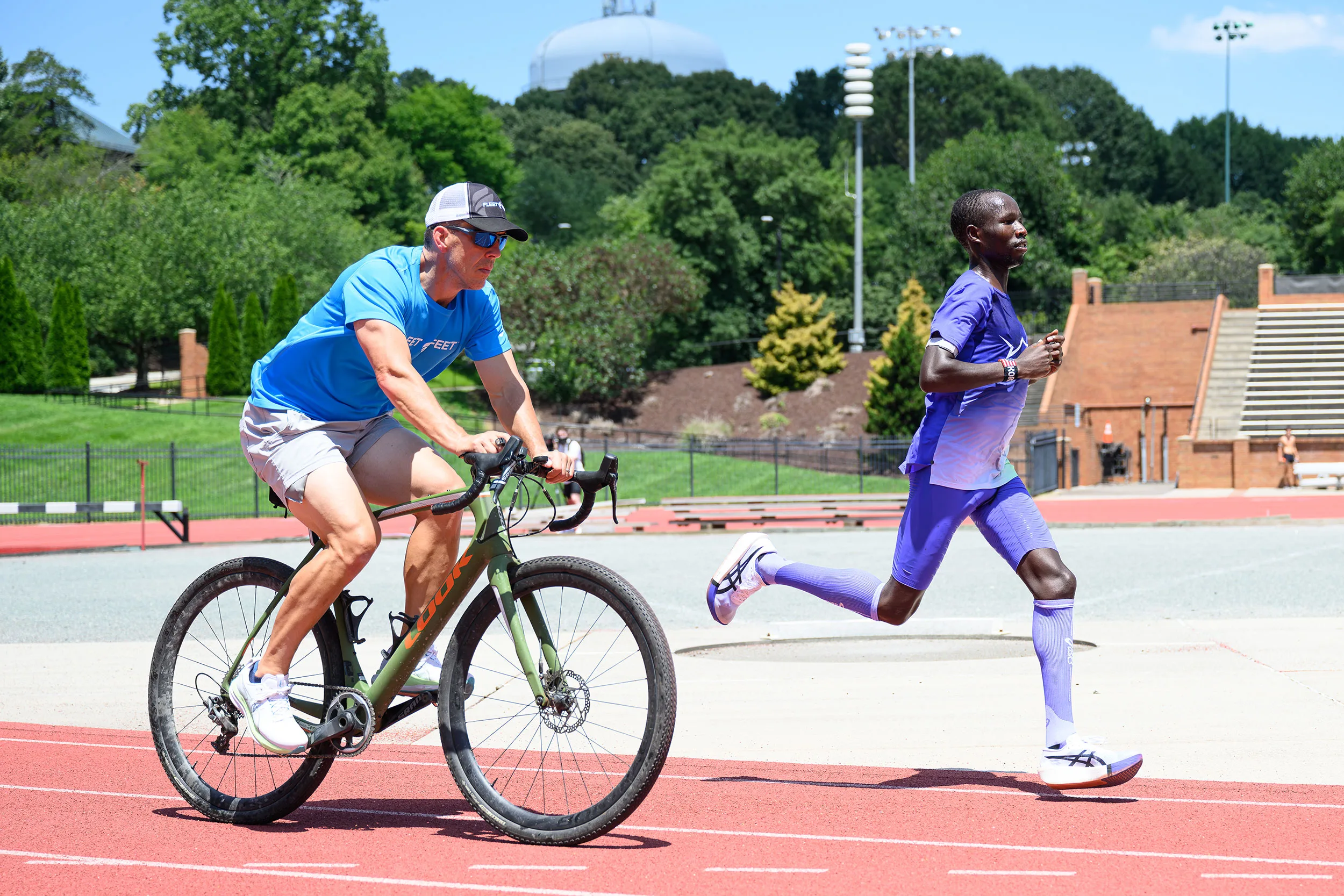
- Run successive repeats around the Kentner track, gradually increasing the pace.
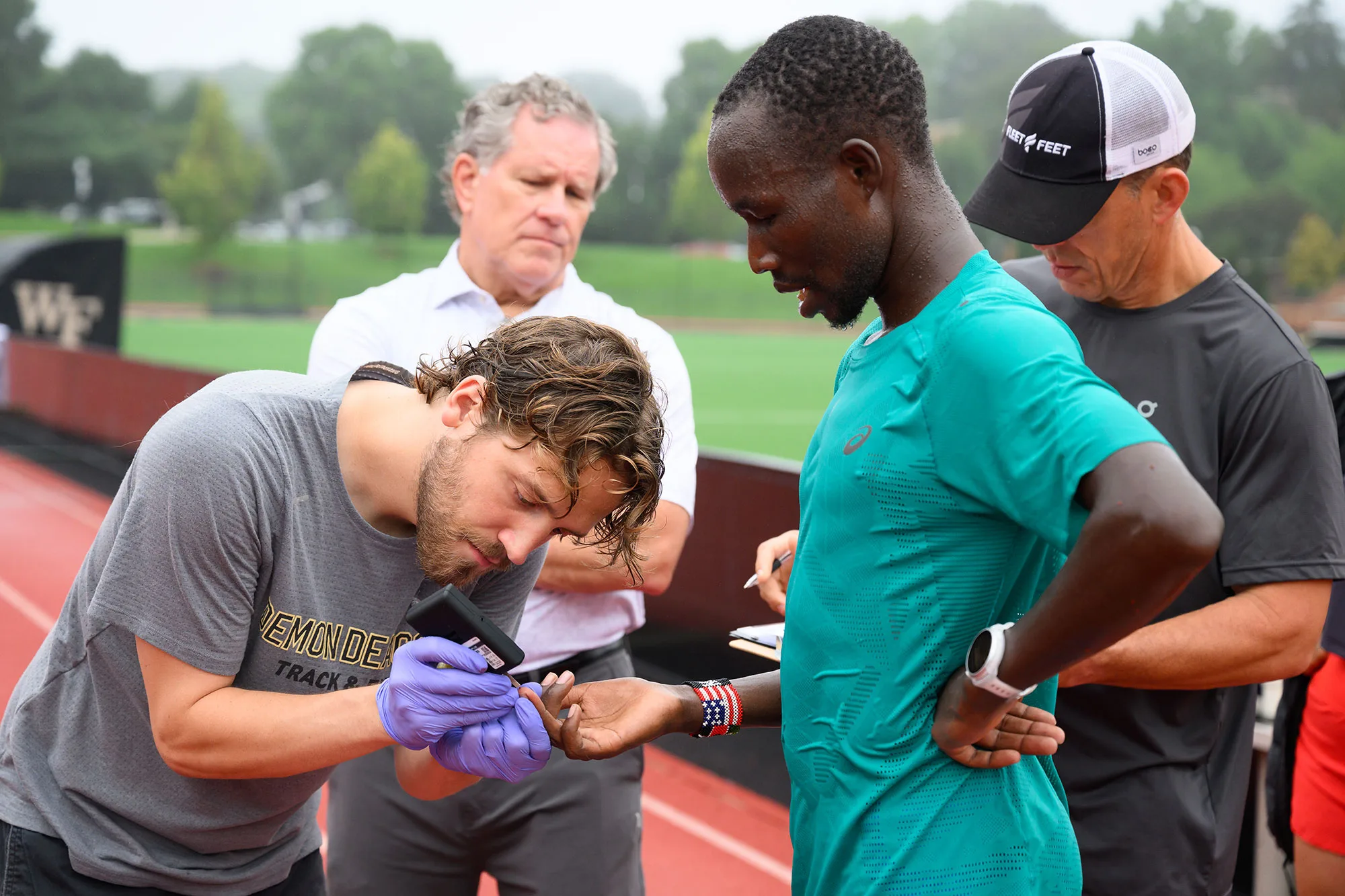
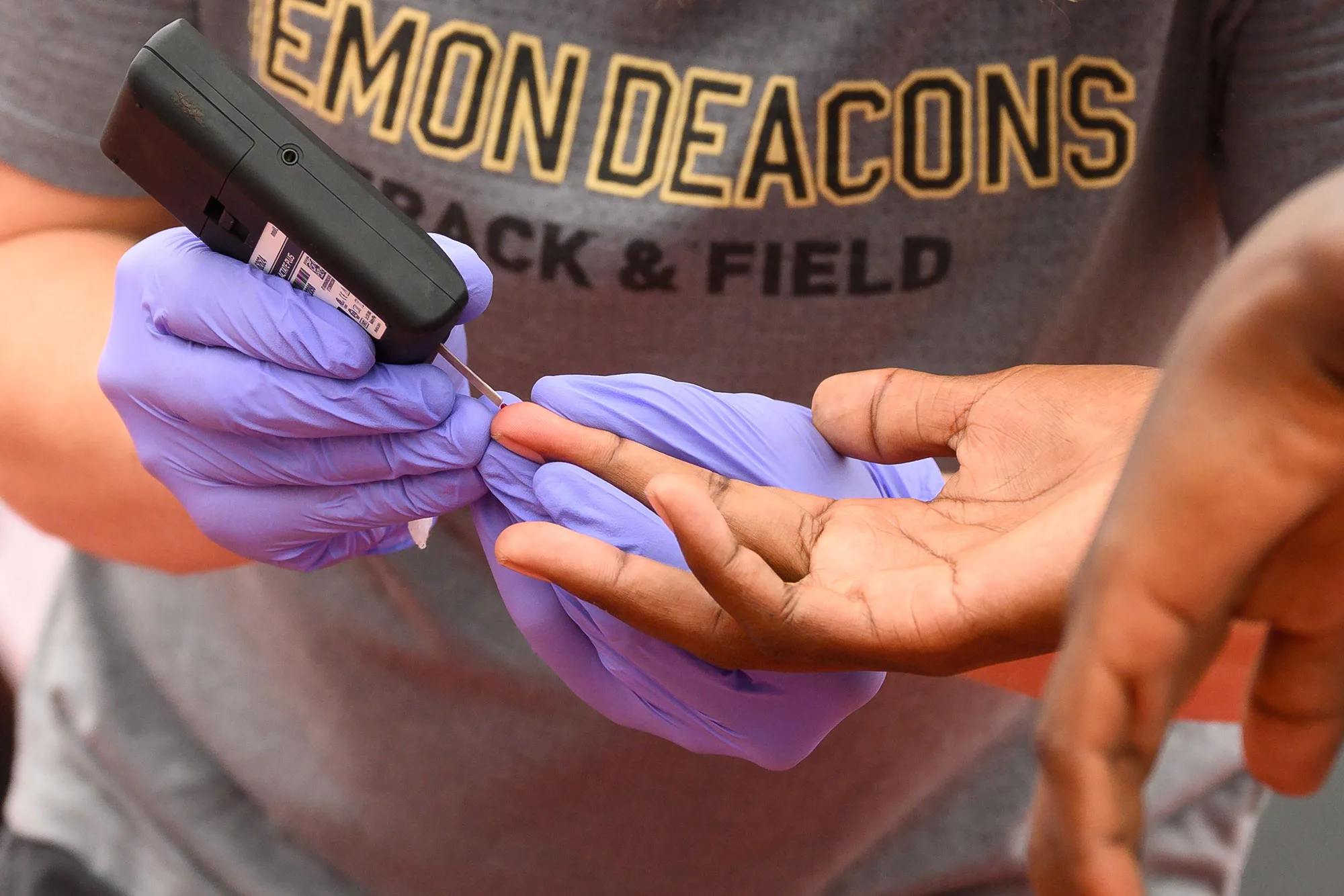
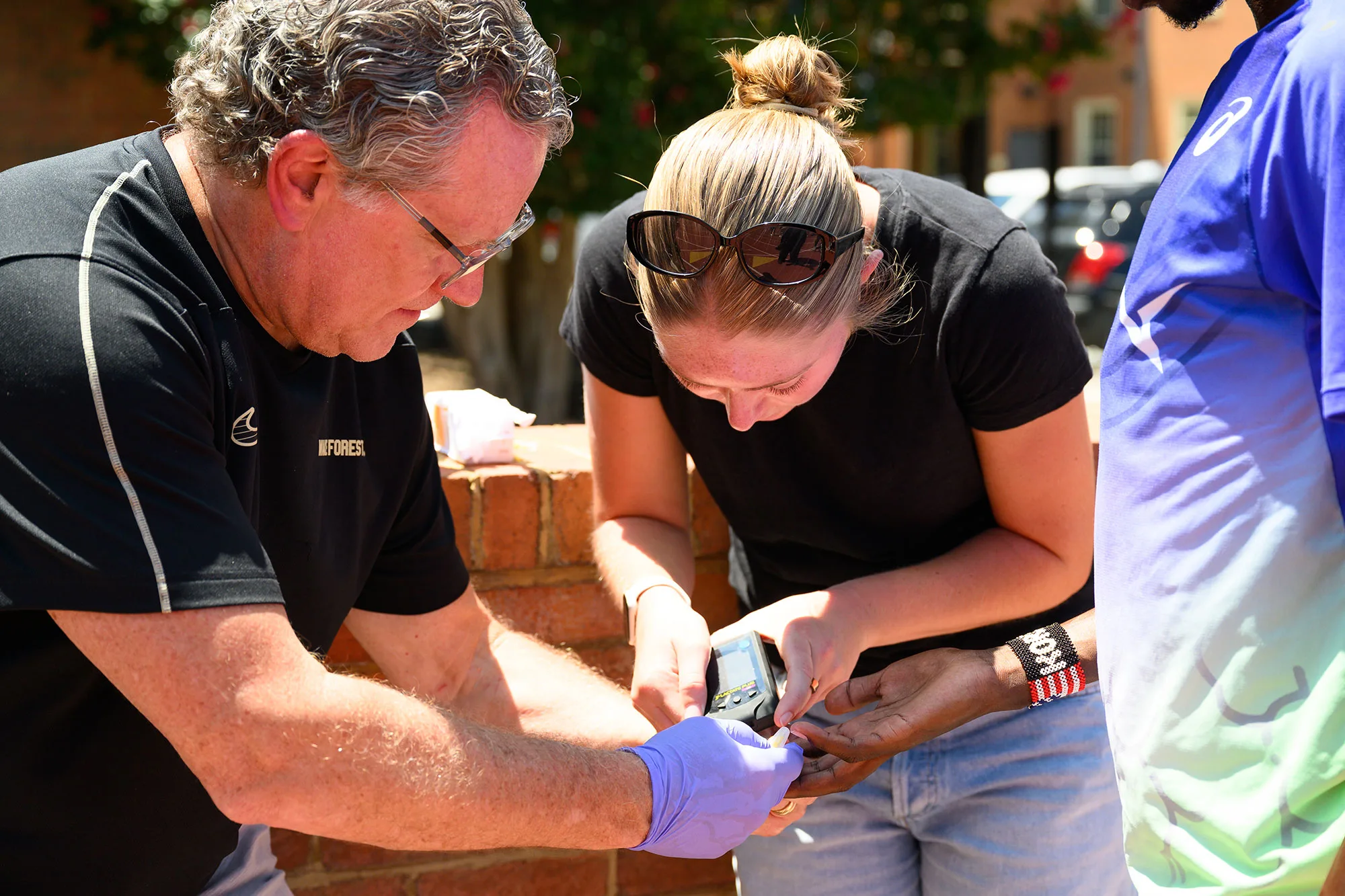
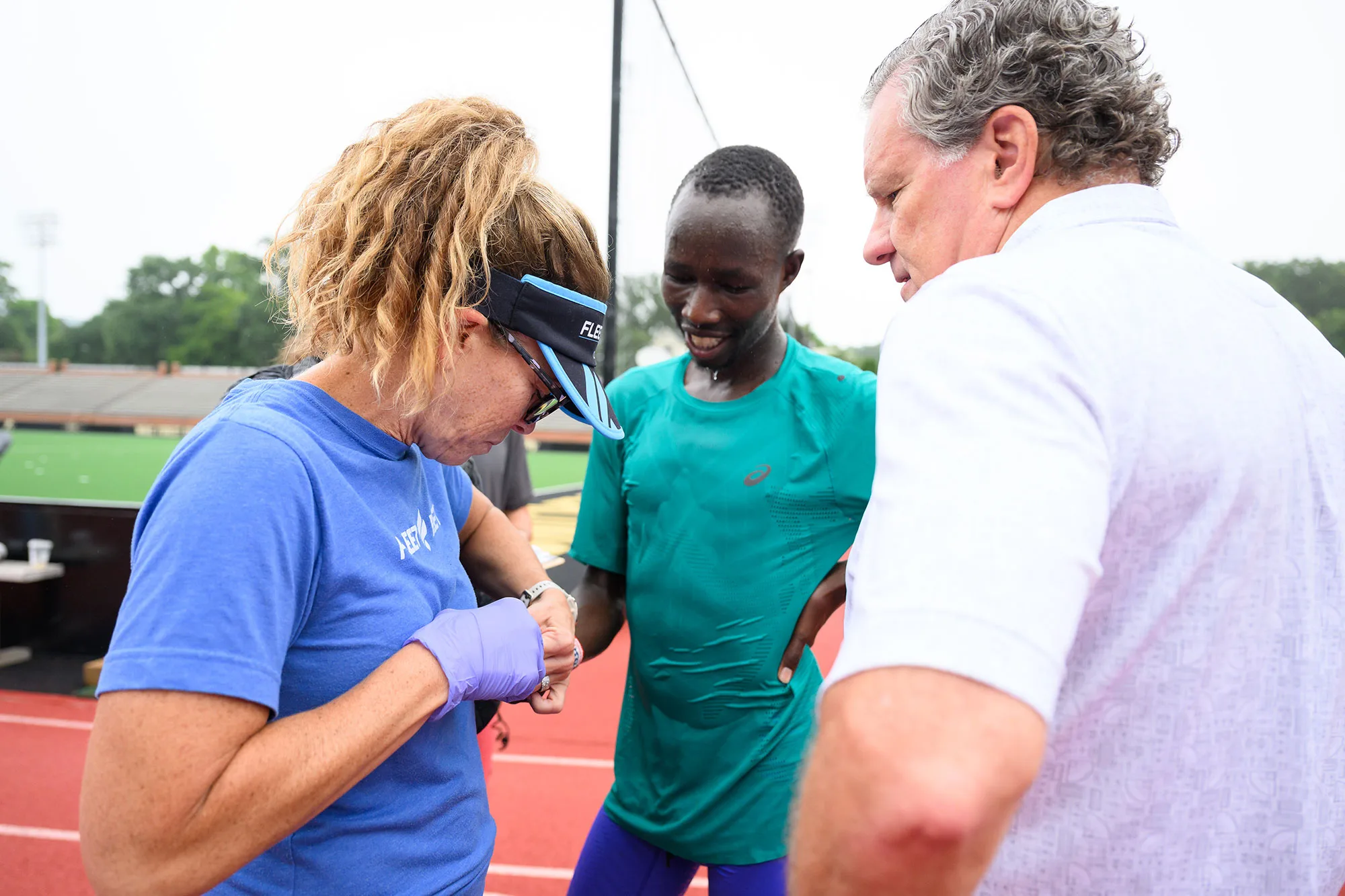
- Stop between each repeat to draw blood via a finger prick, log heart rate data and assess exertion level via the Rating of Perceived Exertion (RPE) chart.
- Repeat until the threshold is determined.
At the track, John LePino, assistant track and field coach at Wake Forest, did the blood draws. Josie Rill, an undergraduate researcher in Brubaker’s lab, logged the corresponding lactate levels, heart rate and exertion levels from the RPE.
Using data to boost performance
The research team had Korir do the test twice for comparison—first, on a hot and humid Friday afternoon, in the full sun. Then, he came back early Monday morning, when conditions were cloudy and cooler.
Using the data collected both days, Brubaker prepared a scientific synopsis for Mann, who will use it to fine-tune Korir’s training plan leading up to the Valencia Marathon in Spain in December.
Standing at the Kentner track’s southwest turn, stopwatch in hand, Mann called out distance, pace and encouragement to Korir as he ran laps that built up to marathon pace.
In addition to finding out the “tipping point on lactate” during Korir’s visit to Wake Forest, Mann wanted to show this elite runner that the science backs up his ability to perform at a higher level.
“The data gives great confidence … that he can be the best marathoner in the world,” Mann said. “Seeing this information and knowing that he can replicate it on a marathon course gives John Korir great resolve moving forward. … He now knows through science that his future is bright for many years to come at the apex in marathoning.”
Collaborating for good
Emily and Keith Davis, owners of Fleet Feet Winston-Salem and Fleet Feet Clemmons, have had a front row seat to Korir’s training over the past several years.
The couple, who both received their MBAs from Wake Forest University School of Business, have been serving in Kenya since 2014 and got connected with the Korir family on ministry efforts in 2020.
So when Mann asked Emily Davis about lactate testing in Winston-Salem, she knew to reach out to HES for its testing labs.
“Any other athlete at this level would have been tested for all this type of data,” she said. “In Africa, it’s not readily available. For John, it’s not been available.”
Emily Davis now serves as vice president of the Kenyan Kids Foundation, which governs the Transcend Talent Academy. The elite school in Kenya was founded by John Korir’s older brother, Wesley, to lift young Kenyans out of poverty.
Making a difference together
Wesley Korir won the 2012 Boston Marathon and was the first to win the Los Angeles Marathon in back-to-back years. John Korir dedicates 10% of his winnings to Transcend. And the Davises now raise money for the school through the Kenyan Kids Foundation.
Brubaker calls it a perfect example of Pro Humanitate in action: Wake Foresters collaborating to make a difference at home and across the globe.
“Hopefully, this is just the beginning of the work we will do with John Korir,” Brubaker said. “We have all the elements in place at Wake to add more science to his training.”


Recent News
Celebrating 20 years of undergraduate research and discovery
Celebrating 20 years of undergraduate research and discovery
What the neuroscience of motivation has to say about GLP-1 drugs
What the neuroscience of motivation has to say about GLP-1 drugs