Putting sustainability to work
Green-collar jobs grew by more than 9 percent, twice the growth rate for traditional jobs, from 1998 to 2007. Even during a recession, a "greener resume" can be the answer to getting hired, says Director of Sustainability Dedee DeLongpre Johnston.
Eco-fashion is one of the biggest trends of the decade, and designers are offering more stylish and affordable clothing as consumer demand rises. That's why Wake Forest's sustainability office and eco-designer Jenny Hwa are co-hosting a fashion show of eco-chic clothing and accessories. Scheduled for April 6, Sustainable Style WSNC will be the first of its kind in the Winston-Salem area. Models will wear shirts, skirts, dresses and jewelry from more than a dozen top designers.
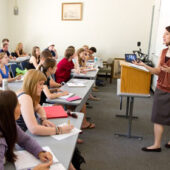
As colleges and universities prepare students to lead the green jobs revolution, they will take a variety of approaches to integrating sustainability into academics. One shade of green doesn’t suit every college and university, says Dedee DeLongpré Johnston, director of sustainability at Wake Forest.
For most high school students, learning happens one individual discipline at a time. But in the world outside the classroom, finding solutions to challenges requires looking across disciplines. Wake Forest is starting a summer residential program this year to help high school juniors and seniors learn that the biggest challenges in the world can only be solved by studying a variety of perspectives.
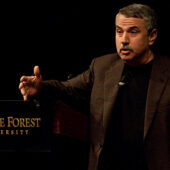
The hour is late, but there is still enough time to launch a true Green Revolution to solve the world's greatest problems that all trace their causes to energy, said best-selling author and New York Times columnist Thomas Friedman in a speech at Wake Forest Wednesday night.
Wake Forest University is bringing together business leaders, leading researchers, entrepreneurs and scholars for a two-day conference to address America's growing energy problem and to lay the groundwork for solutions. Columnist and best-selling author Thomas Friedman will deliver the conference's keynote address.
Last year, Wake Forest students used nearly a quarter of a million polystyrene, clamshell containers for carry-out food from campus dining rooms — about 7,000 containers per week. Containers made from polystyrene foam, more commonly known as Styrofoam, aren't recyclable in the Winston-Salem area.
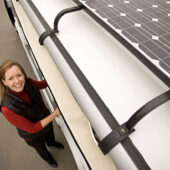
Sustainability director Dedee DeLongpré Johnston received a gift for the campus just in time for the holidays: the newest-model solar-electric hybrid shuttle that will begin serving the campus in 2010.