A way to save the Amazon?
A solution to reverse Amazon rainforest deforestation is being explored by Wake Forest researchers by creating a new and more effective version of biochar made from native bamboos. Biochar is a kind of fertilizer made by smoldering agricultural plant waste in a specially designed, zero-oxygen kiln.
Wake Forest prioritizes engagement inside and outside of the classroom. With an 11:1 student-faculty ratio, the Faculty Fellows program is an extension of the University’s teacher-scholar model.
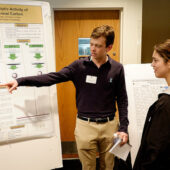
Sophomore Hannah Martin and Patricia Dos Santos, an associate professor of chemistry, are tackling the problem of how to target harmful bacteria while sparing beneficial bacteria that make it possible for humans to live healthy lives.
Thanks to the largest fundraising year in University history, Wake Will: The Campaign for Wake Forest has raised more than $402 million of the $600 million Reynolda Campus goal, making it possible for students like Sarah Millsaps ('16) to say "yes" to Wake Forest.
Arts and humanities offer opportunities to learn about life through a variety of lenses. A new interdisciplinary program and a class where theatre students help train counseling students are just two examples of how Wake Forest combines imagination and insight.
From improving the lives of people suffering from debilitating diseases to turning waves in the Reynolds gym pool into electricity, Wake Forest researchers raised the bar of scientific excellence yet again during the 2013-2014 academic year.
Wake Foresters inspire and uphold campus traditions new and old. Throughout the academic year, students serve, lead and share fellowship in the spirit of Pro Humanitate.
Wake Forest Chemist Amanda Jones is the recipient of the National Science Foundation's prestigious Career Award. Jones will use the $390,000 in award funding to study powerful and environmentally friendly gold catalysts for use in the pharmaceutical industry.
Molly Dutmers is one of 14 students reporting from Europe with Wake Forest's first journalism class abroad. She is also Wake Forest’s third recipient of the Pulitzer Center on Crisis Reporting’s student fellowship. Her travels will take her to France, Italy and Malta to report on why church attendance is at an all-time low.
The key to developing drought-resistant tomatoes may be hidden in the genes of their ancestors. Rising junior Kathleen DiNapoli is on a hunt to find it.